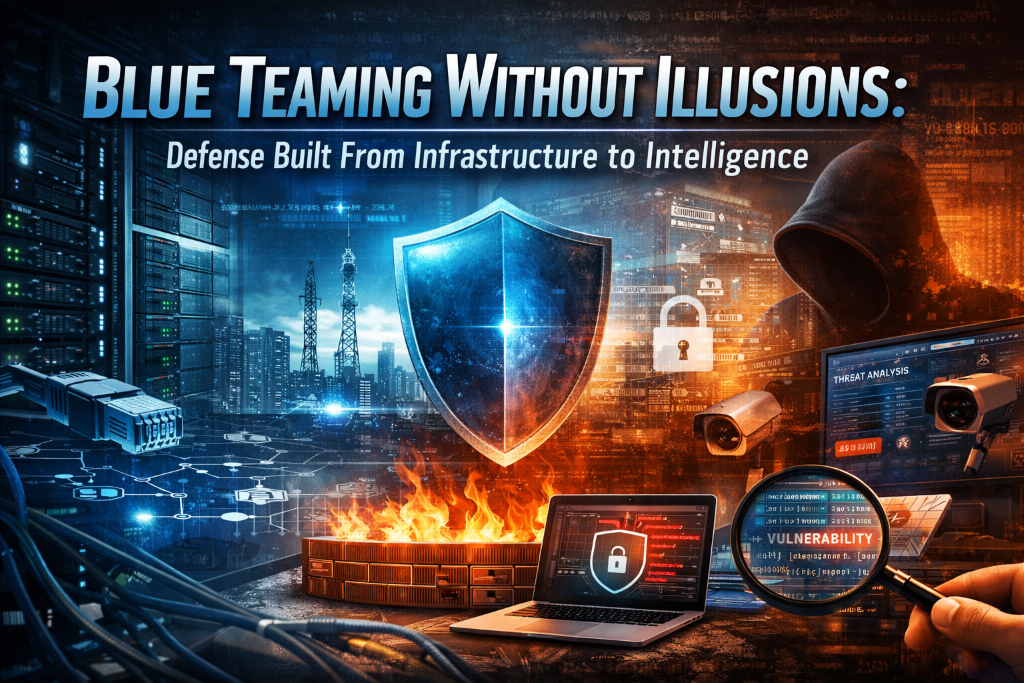
Cybersecurity is often marketed as speed, automation, and artificial intelligence.
But real blue team defense is something else entirely.
It is architecture.
It is discipline.
It is visibility.
It is recovery.
It is restraint.
My journey into defensive security did not begin in a SOC.
It began in server rooms, structured cabling, WAN deployments, firewall hardening, traffic monitoring, and restoring production systems while phones rang relentlessly.
And that beginning shaped everything.
Because when you have built the infrastructure with your own hands, you defend it differently.
Defense Starts Before Detection
Many organizations treat security as something layered on top of operations.
In reality, defense begins at the foundation:
• VLAN segmentation to control blast radius
• Port security and MAC filtering at Layer 2
• Access governance to reduce privilege sprawl
• Hardened firewall policy architecture
• Clean change management practices
• Backup integrity validation
• Reliable monitoring baselines
Segmentation is not a design preference.
It is damage containment waiting to prove its value.
Flat networks do not get breached.
They get consumed.
Visibility Is the Difference Between Guessing and Knowing
Over time, I’ve worked across monitoring and detection platforms that provided:
• Real-time infrastructure health monitoring
• Network performance tracking
• Traffic flow analysis
• Configuration change auditing
• File integrity monitoring
• Log aggregation and alert correlation
• Insider threat detection
• Data loss prevention
• Endpoint detection and response
• Vulnerability scanning and exposure validation
What matters is not the logo on the dashboard.
What matters is what the system is capable of revealing:
• Who changed what.
• When it changed.
• Whether that change was authorized.
• What files were modified.
• What data left the environment.
• Which device initiated suspicious behavior.
• Where lateral movement began.
• What vulnerability was exploitable, and why it wasn’t patched.
Monitoring without context creates noise.
Monitoring with baselines creates intelligence.
And intelligence reduces panic.
The Silent Guardians: Controls Most Organizations Underestimate
Some of the most powerful defensive mechanisms I’ve implemented and managed include:
File Integrity Monitoring (FIM)
Detecting unauthorized modification of critical system files and configurations, because subtle tampering is often the beginning of compromise.
Data Loss Prevention (DLP)
Monitoring and controlling the movement of sensitive data, not only against external threats, but insider risk.
Vulnerability Assessment & Detection
Continuous scanning to identify exploitable weaknesses before adversaries do.
Because exposure without visibility is silent risk.
Endpoint Detection & Response (EDR)
Behavior-based monitoring that detects anomalies beyond signature-based antivirus limitations.
Network Traffic Analysis (NTA)
Understanding east-west and north-south traffic flows to identify abnormal communication patterns.
Network Performance & Configuration Monitoring
Tracking configuration drift, unauthorized changes, and performance degradation.
A configuration change in the wrong place can be more dangerous than malware.
Endpoint Encryption
Protecting data at rest so device loss does not become data compromise.
Firewall Policy Engineering
Designing access rules that are secure, auditable, minimal, and sustainable.
Temporary exceptions are rarely temporary.
From Alerts to Assurance
Security tools can generate thousands of alerts.
But alerts alone do not create resilience.
Real resilience requires:
• Understanding system behavior under normal load
• Knowing which alerts matter
• Tuning detection rules intelligently
• Reviewing logs proactively
• Cleaning dormant privileges
• Auditing access paths
• Testing backups
• Documenting changes
Because when an incident happens, clarity is survival.
Incident Response Is Where Theory Gets Humbled
In real environments, I’ve handled:
• Terabytes of data recovery
• Logical storage corruption repair
• Authentication bypass during failed upgrades
• WAN restoration under operational pressure
• Firewall policy debugging during outages
• Traffic filtering during abnormal spikes
• Privilege containment after suspicious activity
These moments reveal something most professionals learn late:
Security rarely fails dramatically.
It erodes quietly.
Backups weren’t tested.
Logs weren’t reviewed.
Privileges accumulated.
Exceptions lingered.
Changes went undocumented.
Then one day, everything collapses.
Not because of sophistication.
But because of neglect.
Governance: The Multiplier Most Engineers Ignore
Technical defense without governance becomes reactive firefighting.
Governance, Risk, and Compliance alignment transforms chaos into measurable security posture.
True maturity includes:
• Periodic access reviews
• Documented change control workflows
• Risk assessment mapping
• Policy-to-technical-control alignment
• Evidence collection for audit defensibility
• Configuration documentation
• Incident documentation with lessons learned
A firewall rule without documentation is a liability.
A policy without enforcement is decoration.
Blue team maturity bridges engineering and accountability.
The Psychology of Blue Teaming
Technical skill matters.
But composure matters more.
During outages and incidents, the most valuable skills are:
• Controlled response
• Methodical troubleshooting
• Clear communication
• Prioritized containment
• Evidence preservation
• Recovery discipline
The best defenders are calm while others escalate.
That calm is earned, not installed.
Infrastructure Experience Changes the Defender
Many defenders begin at the detection layer.
I began at the infrastructure layer.
Pulling cables.
Designing WAN links.
Terminating patch panels.
Deploying wireless bridges.
Hardening switches.
Configuring firewalls.
Monitoring live traffic.
Recovering failed systems.
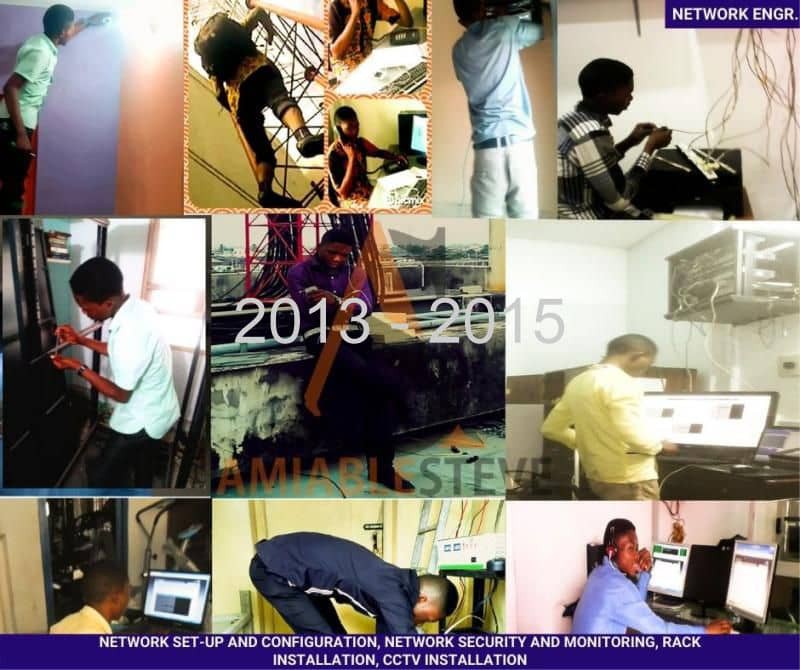
When you understand the wiring beneath the dashboard,
you recognize fragility before it becomes failure.
And that perspective cannot be downloaded.
What Blue Team Excellence Actually Looks Like
Not hype.
Not tool obsession.
Not fear marketing.
It looks like:
• Segmented architecture
• Hardened endpoints
• Intelligent monitoring
• Clean firewall policies
• Continuous vulnerability management
• Data movement control
• File integrity validation
• Encrypted devices
• Tested backups
• Reviewed logs
• Documented changes
• Least privilege access
• Calm incident response
It is quiet.
It is methodical.
It is intentional.
And when done well,
it makes crises uneventful.
Final Reflection
Technology evolves.
Threat actors evolve.
Detection platforms evolve.
But the fundamentals do not.
Segment deliberately.
Monitor intelligently.
Audit consistently.
Test backups.
Review privileges.
Validate vulnerabilities.
Document everything.
Design for failure.
Recover confidently.
Because in the end, blue team success is not measured by how impressive your tools look.
It is measured by how stable your environment remains when pressure arrives.
And stability,
in cybersecurity,
is the ultimate proof of competence.
I am STEPHEN JOSEPH, Cyber Security Professional with 12+ Years in IT
Technical Director, Elite Comp Tech,
Twiiter Handle: AMIABLESTEVE
https://www.linkedin.com/in/amiablestephenjoseph/