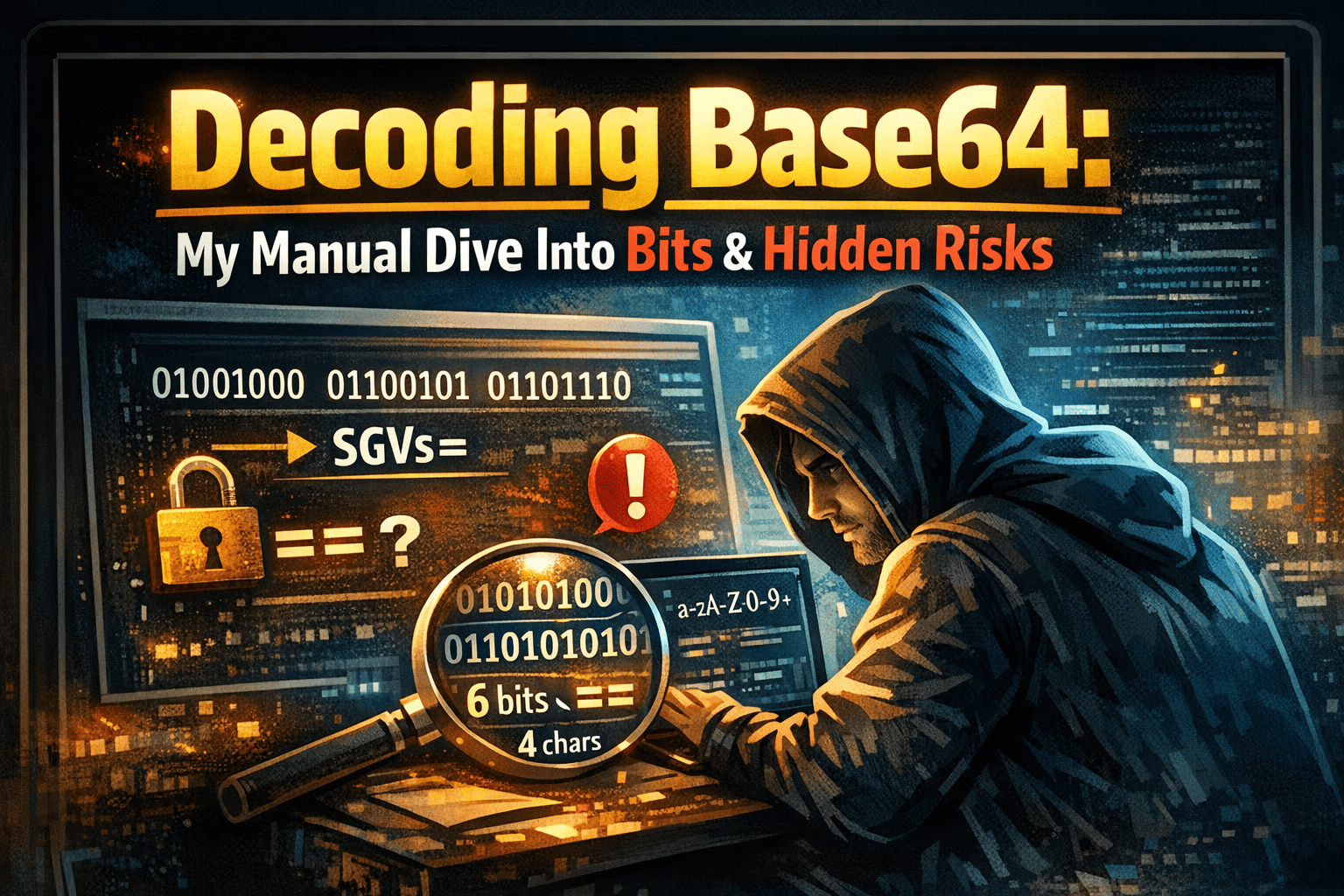
Introduction
I have been working on my set of security tools like a URL Masker and a secure file Shredder.
This time I decided to learn more about something we use every day in security work: Base64 Encoding and Decoding.
I could have just used Pythons base64 library. Been done with it in two lines.
As security researchers we do not trust things we do not understand.
We like to break them down rebuild them and learn how they work.
So I built Base64 from scratch bit by bit.
I found a small problem that can actually cause issues.
1. The Problem with Data Transmission
The problem with data is that it can be misunderstood by old systems.
These systems were designed to work with text like email.
Binary data has bytes that can be seen as “end of file” or “control characters” or even “invalid text”.
This can cause problems and corrupt the data.
2. What Base64 Does
Base64 is a way to convert data into a safe set of characters that can be sent anywhere.
It uses a set of 64 characters like letters and numbers to represent the binary data.
3. Core Concept: The 3-to-4 Rule
The core idea of Base64 is the “3-to-4” rule.
This means that 3 bytes of binary data become 4 characters in Base64.
Each character in Base64 represents 6 bits of data.
So 3 bytes, which are 24 bits become 4 characters.
4. How I Built It (Step-by-Step)
- To build Base64 I followed these steps:
- I converted the input into a stream.
- For example the word “Hel” becomes a series of binary numbers.
- Then I broke the stream into small chunks of 6 bits each.
- I used a method to do this.
- Next I mapped each chunk to a character in the Base64 alphabet.
- Each value corresponds to a character.
- The final output is the Base64 encoded string.
5. Padding Logic
If the input is not a multiple of 3 bytes I used padding to make it work.
The padding is done using “=” characters.
6. Hidden Trap: Newline Issue
But here is the part: I found a hidden trap.
While testing my tool I found that a hidden newline character was being added to the input.
This changed the output. Caused problems.
7. Security Insight
This tiny issue can actually reveal information about the system.
It can show how the backend works or if there are flaws in the input handling.
Invisible characters can change the encoding structure.
8. Challenges Faced
Building this tool was not easy.
I faced challenges like understanding how to convert 8-bit data to 6-bit data without losing information.
I also had to be careful with the chunk slicing logic to avoid errors.
I had to make sure the padding calculation was correct.
The biggest challenge was the hidden characters.
The newline bug taught me to verify the raw input and never trust it blindly.
This is how real-world bugs happen.
- Source Code
I have published the full source code of my Base64 implementation, on [https://github.com/Darkshadow-9000/py-base64-toolkit] please feel free to check it out and let me know if it can be improved.
#WRAP