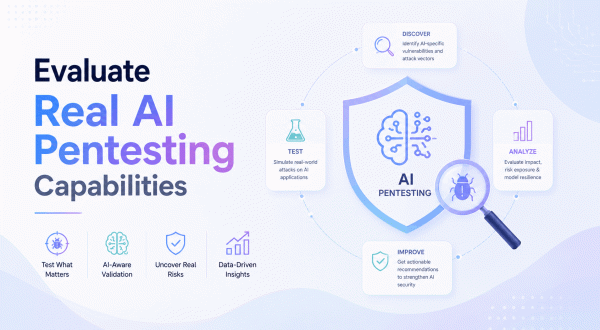
Artificial intelligence has become one of the most overused terms in cybersecurity. Almost every security vendor now claims to offer AI-powered penetration testing, autonomous vulnerability discovery, or intelligent attack simulation. While some platforms genuinely advance application security, others simply add AI branding to traditional automation without introducing meaningful improvements.
For security professionals, this creates a new challenge. The question is no longer whether a platform uses AI, but whether that AI actually improves offensive security testing. Distinguishing genuine capabilities from marketing claims has become a critical part of every product evaluation.
Understanding What Real AI Pentesting Looks Like
Before evaluating vendors, security teams should first understand how to identify genuine AI pentesting capabilities instead of relying on product messaging or feature comparisons alone. A structured evaluation framework makes it easier to separate platforms that validate real attack paths from those that simply automate vulnerability scanning.
Not every AI-powered security product operates at the same level. Most solutions fall into one of three categories:
- Rule-Based Automation: Executes predefined scans using fixed testing logic.
- AI-Assisted Testing: Uses AI to improve vulnerability discovery while relying on human validation.
- Autonomous AI Pentesting: Dynamically discovers assets, adapts testing strategies, chains vulnerabilities, and validates exploitability with minimal human intervention.
Understanding these differences prevents organizations from comparing fundamentally different technologies as though they provide the same level of protection.
Validation Should Always Come Before Detection
Many products advertise the number of vulnerabilities they can identify.
That metric alone tells very little.
A security team gains far more value from ten verified vulnerabilities than hundreds of unconfirmed alerts that require manual investigation.
When evaluating a platform, ask questions such as:
- Does it validate exploitability before reporting findings?
- Can it provide reproducible evidence?
- Does it reduce false positives?
- Are findings prioritized according to actual business risk?
Platforms capable of answering these questions consistently provide significantly greater operational value.
Evaluate Coverage Instead of Marketing Claims
Attackers rarely limit themselves to a single webpage.
Modern applications include:
- Single Page Applications (SPAs)
- REST APIs
- GraphQL APIs
- Authenticated dashboards
- Cloud-native services
- Business workflows
- Third-party integrations
An effective AI pentesting platform should evaluate these attack surfaces together rather than focusing exclusively on publicly exposed endpoints.
Broad testing coverage demonstrates technical maturity, while limited visibility often reveals that the platform is built on older scanning methodologies.
Attack Chaining Separates Advanced Platforms
One of the clearest indicators of genuine AI capability is attack chaining.
Rather than reporting isolated vulnerabilities, advanced platforms understand how multiple weaknesses can interact.
For example, a low-risk information disclosure could expose credentials that enable privilege escalation before ultimately leading to unauthorized access.
Platforms capable of discovering these relationships provide security teams with a far more realistic assessment of organizational risk than independent vulnerability lists.
Reporting Should Support Security Decisions
Generating reports is easy.
Generating reports that developers can actually use is much more difficult.
A useful AI pentesting platform should provide:
- Clear technical evidence.
- Risk-based prioritization.
- Actionable remediation guidance.
- Context explaining why the finding matters.
Reports should help engineering teams fix vulnerabilities rather than simply documenting them.
Operational Integration Is Often Overlooked
Many organizations evaluate security features without considering operational adoption.
Ask whether the platform integrates with:
- CI/CD pipelines
- Jira
- ServiceNow
- SIEM platforms
- DevSecOps workflows
Security testing only becomes valuable when it fits naturally into existing engineering processes.
A platform that requires significant manual effort is unlikely to support continuous security validation at enterprise scale.
Governance Matters More Than Most Buyers Expect
Automated offensive testing introduces operational responsibilities alongside technical capabilities.
During evaluation, review whether the platform includes:
- Testing scope controls.
- Production safeguards.
- Audit logging.
- Role-based access.
- Emergency stop mechanisms.
These governance capabilities ensure security testing remains controlled while protecting production environments from unintended disruption.
Common Signs of AI Washing
The cybersecurity market contains many products that advertise AI without demonstrating meaningful intelligence.
Some common warning signs include:
- Generic AI marketing with limited technical explanation.
- Large volumes of false positives.
- Static testing behavior across different applications.
- Heavy dependence on manual validation.
- Minimal transparency regarding testing methodology.
Whenever possible, ask vendors to demonstrate live testing instead of relying solely on presentations or product documentation.
Real platforms should clearly explain how they discover assets, adapt attack strategies, validate findings, and prioritize business risk.
Build an Evaluation Process, Not a Vendor Shortlist
One of the most common mistakes organizations make is beginning vendor selection before defining evaluation criteria.
Instead, establish measurable requirements covering:
- Validation accuracy.
- Application coverage.
- Autonomous testing.
- Operational integration.
- Governance.
- Scalability.
- Reporting quality.
With these criteria in place, it becomes much easier to distinguish genuine engineering innovation from AI-enhanced marketing language.
Final Thoughts
AI is transforming penetration testing, but it has also made vendor selection significantly more complex. Security professionals must evaluate platforms based on technical capabilities, validated results, and operational fit rather than impressive terminology or promotional claims.
Organizations that prioritize evidence over marketing, automation over assumptions, and measurable outcomes over feature lists will be better equipped to identify AI pentesting platforms that deliver lasting security value while avoiding the growing problem of AI washing.