Artificial Intelligence (AI) has become one of the most transformative technologies of the modern era. From facial recognition and voice assistants to self-driving cars and medical diagnosis, many of today’s intelligent systems rely on Neural Networks.
But have you ever wondered how a neural network actually learns?
Unlike traditional computer programs that follow fixed instructions, neural networks improve their performance by learning from data. They recognize patterns, make predictions, identify relationships, and become more accurate over time.
In this article, we’ll explore how neural networks learn in a simple, step-by-step manner without requiring an advanced mathematics background.
What is a Neural Network?
A Neural Network is a machine learning model inspired by the way neurons in the human brain communicate with one another.
Instead of biological neurons, artificial neural networks consist of nodes (neurons) connected together.
A basic neural network contains three main layers:
- Input Layer – Receives the input data.
- Hidden Layer(s) – Processes the information and learns patterns.
- Output Layer – Produces the final prediction.
For example, imagine a neural network trained to recognize whether an image contains a cat or a dog.
The image enters the input layer, passes through multiple hidden layers where features are extracted, and finally reaches the output layer, which predicts the correct animal.
Why Do Neural Networks Need to Learn?
When a neural network is first created, it knows absolutely nothing.
Its internal parameters, called weights, are initialized with random values.
As a result, its first predictions are usually incorrect.
The learning process is simply the network adjusting these weights until its predictions become more accurate.
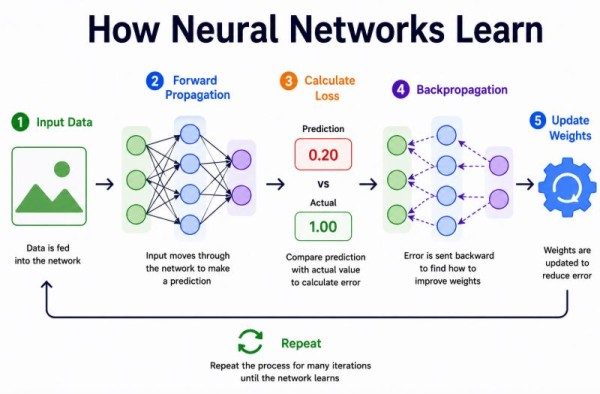
Step 1: Feeding the Input
Learning begins by providing training data.
Suppose we want to build an image classifier.
Our dataset contains thousands of images labeled as:
Each image is converted into numerical values because neural networks understand numbers rather than pictures.
These values are passed into the input layer.
Step 2: Forward Propagation
The information now travels through the network.
Each neuron performs a simple calculation:
- Multiply each input by a weight.
- Add the results together.
- Apply an activation function.
- Pass the output to the next layer.
This process continues until the output layer generates a prediction.
For example:
Actual label:
Cat
Predicted result:
Dog
Since the prediction is wrong, the network needs to learn from its mistake.
Step 3: Calculating the Error
The next step is measuring how far the prediction is from the correct answer.
This difference is called the Loss or Error.
A loss function calculates this value.
A small loss means the prediction is close to the correct answer.
A large loss means the prediction is poor.
The goal of training is to reduce this loss as much as possible.
Step 4: Backpropagation
Backpropagation is the process that allows the neural network to learn from its mistakes.
Instead of simply saying:
The prediction was wrong.
Backpropagation determines:
- Which neurons contributed to the error
- Which weights caused the mistake
- How much each weight should change
The error is propagated backward through the network, layer by layer.
This is why it is called Backpropagation.
Step 5: Updating the Weights
After identifying the error, the network updates its weights.
This is performed using an optimization algorithm.
The most common optimizer is Gradient Descent.
Its goal is simple:
Move the weights in the direction that reduces the loss.
Small improvements are made after every training example or batch of examples.
Over time, the predictions become increasingly accurate.
Understanding Gradient Descent with a Simple Example
Imagine standing on top of a mountain while blindfolded.
Your goal is to reach the lowest point in the valley.
You take small steps downhill.
After every step, you check whether you’re getting closer to the bottom.
Eventually, you reach the lowest point.
Gradient Descent works in a very similar way.
Instead of walking down a mountain, it adjusts the model’s weights to minimize prediction errors.
What Are Epochs?
One complete pass through the entire training dataset is called an Epoch.
For example:
If your dataset contains 10,000 images:
- Epoch 1 → The model sees all 10,000 images once.
- Epoch 2 → It sees them again.
- Epoch 3 → It continues learning from the same data.
Neural networks usually require many epochs before achieving good performance.
What Is a Batch?
Training data is often divided into smaller groups called Batches.
Instead of processing every image at once, the model learns from a small batch, updates its weights, and then moves to the next batch.
Batch training:
- Requires less memory
- Speeds up training
- Improves optimization
Activation Functions
Neurons use activation functions to decide whether important information should continue through the network.
Common activation functions include:
- ReLU
- Sigmoid
- Tanh
- Softmax
These functions help neural networks learn complex patterns that simple linear models cannot.
Why Do Hidden Layers Matter?
Hidden layers enable neural networks to discover increasingly complex features.
For an image classification task:
The first hidden layer may identify:
The second layer may recognize:
The deeper layers combine these features to identify an entire animal.
This layered learning process makes deep learning highly effective for computer vision, speech recognition, and natural language processing.
A Real-World Example
Imagine teaching a child to identify apples and oranges.
Initially, the child makes many mistakes.
Each time you correct them, they begin noticing useful features such as:
After seeing hundreds of examples, they can classify fruits accurately.
A neural network learns in a similar way.
It studies examples, receives feedback, corrects mistakes, and gradually improves.
Common Challenges During Training
Neural networks do not always learn perfectly.
Some common problems include:
Overfitting
The model memorizes the training data instead of learning general patterns.
It performs well during training but poorly on new data.
Underfitting
The model is too simple to capture the underlying patterns.
As a result, it performs poorly on both training and testing data.
Vanishing Gradient
In very deep neural networks, gradients may become extremely small.
This slows or even prevents learning in earlier layers.
Modern architectures and activation functions help reduce this issue.
How Long Does Training Take?
Training time depends on several factors:
- Dataset size
- Number of layers
- Number of parameters
- GPU availability
- Batch size
- Learning rate
Small neural networks may train in minutes, while state-of-the-art Large Language Models require weeks or even months using thousands of GPUs.
Applications of Neural Networks
Neural networks power many AI applications, including:
- Image Recognition
- Speech Recognition
- Machine Translation
- Recommendation Systems
- Fraud Detection
- Medical Diagnosis
- Self-Driving Cars
- Chatbots
- Large Language Models (LLMs)
- Cybersecurity Threat Detection
The Future of Neural Networks
Neural networks continue to evolve rapidly.
Recent advancements include:
- Transformer architectures
- Multimodal AI
- Large Language Models
- Vision-Language Models
- AI Agents
- Edge AI
- Autonomous Robotics
As models become more efficient and powerful, neural networks will play an even greater role across industries.