Imagine noticing an unfamiliar corporate charge on your bank statement or finding a suspicious IP address attempting to access your network. You might also be a researcher tracking a shipping vessel that recently turned off its transponder. In these cases, you need answers quickly, but you do not possess subpoena power or hacking tools.
This is where Open Source Intelligence - commonly known as OSINT comes into play. OSINT involves finding, collecting, and analyzing publicly available data like search engine listings, domain registration records, and corporate registries. Since these resources are legally accessible to anyone, you are conducting a fully ethical investigation. This structured approach helps you solve complex cases using only a web browser.
What is an OSINT investigation?
An OSINT (Open Source Intelligence) investigation is the process of collecting, verifying, and analyzing publicly available information to answer a specific question. Investigators use search engines, public records, WHOIS databases, social media, maps, and other open sources without accessing private systems or bypassing security controls.
What is OSINT and How Does it Work?
Open Source Intelligence - known as OSINT is the practice of gathering and analyzing information from public sources. Digital investigations rely on passive reconnaissance rather than high-level clearance. OSINT works by aggregating data from public directories, network protocols, and archives. When investigators inspect DNS records, WHOIS files, or corporate registers, they collect traces to build a threat profile.
Is OSINT Legal?
Yes, OSINT is legal because it uses publicly available information. Accessing public records, performing domain investigations, and analyzing social media are fully legal in the United States. The boundary between legal OSINT and illegal activity comes down to access controls. Bypassing security controls or exploiting vulnerabilities constitutes hacking—not performing OSINT.
OSINT vs. Cyber Hacking
To understand the boundaries of legal digital investigations, it is helpful to contrast OSINT with cyber hacking. The table below outlines the core differences between passive reconnaissance and active exploitation.
| OSINT | Hacking |
|---|
| Uses public information | Attempts unauthorized access |
| Legal when conducted ethically | May violate laws |
| No exploitation required | Exploitation often involved |
| Uses public records | Uses vulnerabilities |
| Relies on passive reconnaissance | Uses active penetration testing |
Entity Summary
To understand Open Source Intelligence within threat intelligence, review this entity summary. OSINT serves to gather intelligence from publicly accessible sources, is utilized by security analysts and SEO professionals, but is limited by data inaccuracies and varying jurisdictional laws.
How Does an OSINT Investigation Work? A Step-by-Step Guide
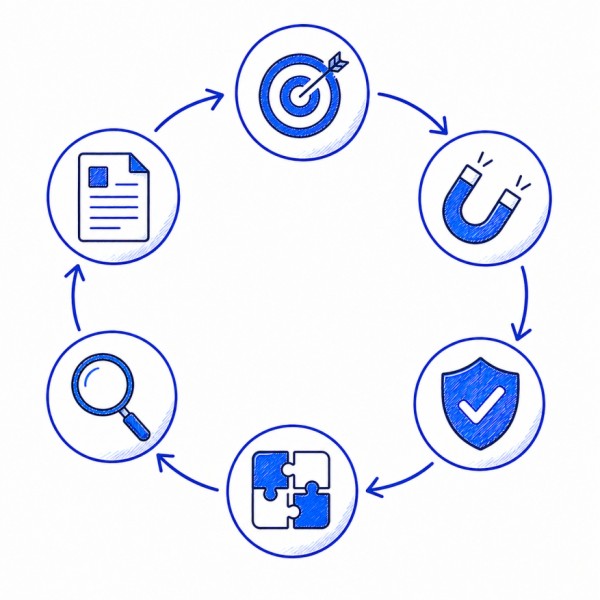
Conducting a successful digital investigation requires a structured methodology. Below is the standard step-by-step process that professional investigators use to trace targets and verify information.
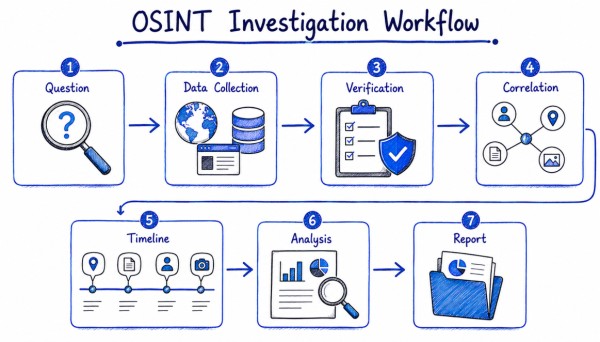
Step 1: Define Your Objective
Many beginner investigations fail because the investigator starts searching without a clear goal. Before opening a search engine, you must define exactly what you want to discover. For instance, your objective might be identifying a company’s officers or performing a comprehensive domain investigation to trace its network infrastructure. Writing this goal on a sticky note helps keep your passive reconnaissance focused and productive.
Step 2: Collect Public Information
This phase focuses entirely on passive information gathering. Passive gathering avoids direct interaction with the target—meaning no emails, pinging servers, or contacting employees. Instead, investigators analyze third-party databases, web caches, and public government registries to trace connections without alerting the target.
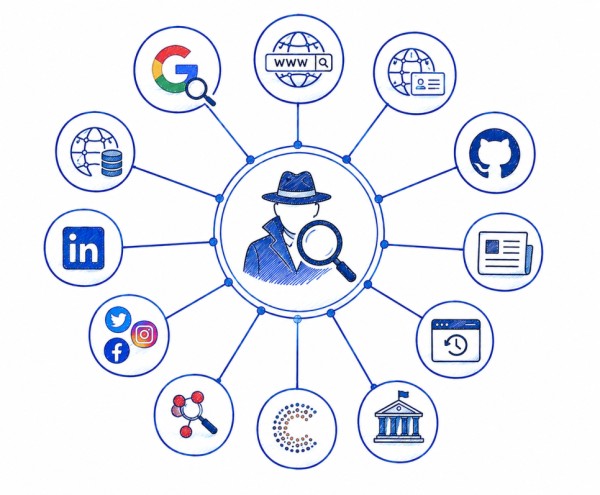
- Google Search: Find news and forum discussions beyond the first results page.
- Google Dorks: Filter web listings using operators like site: and filetype:.
- WHOIS Lookup: Retrieve domain registration dates and registrar details.
- DNS Records: Map domain systems and mail server history.
- Wayback Machine: View cached versions of deleted web content.
- Shodan: Search for internet-connected servers and open ports.
- Censys: Inspect certificates to find hidden subdomains.
- GitHub: Search public code repositories for leaked credentials.
- LinkedIn: Analyze employee structures and corporate roles.
- Social Media Intelligence: Extract locations and relationships from profiles.
- Public Government Records: Search registries for business ownership filings.
- News Articles: Monitor local news for regional events.
Step 3: Verify Your Findings
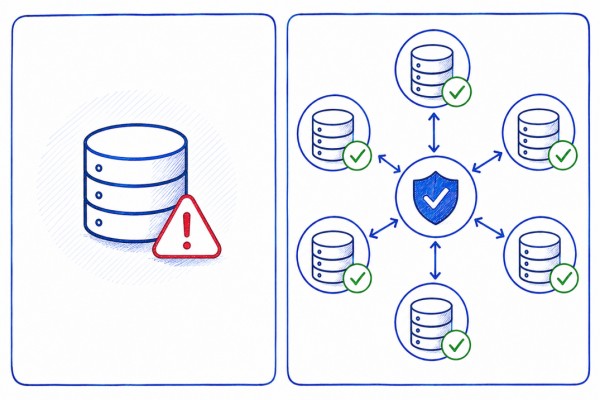
You can never trust a single source in an OSINT investigation. Anyone can create a fake profile or publish a misleading blog post, so relying on one source will compromise your case. To build a report, cross-reference findings across multiple independent repositories. For instance, verify website contact details using official government registries or corporate filing documents.
Step 4: Correlate the Evidence
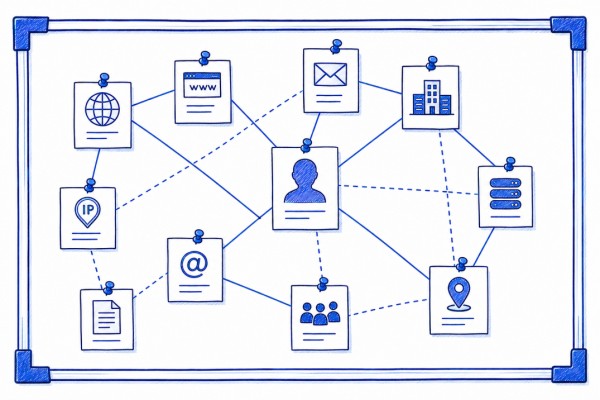
An investigation is rarely about finding a single smoking gun. Instead, you collect seemingly unrelated facts and correlate them to build a coherent picture. You can link organizations, locations, and individuals by tracing shared IP addresses or corporate filings. For example, connecting a shipping vessel’s transponder log with satellite imagery helps verify active cargo loading.
Step 5: Build a Timeline
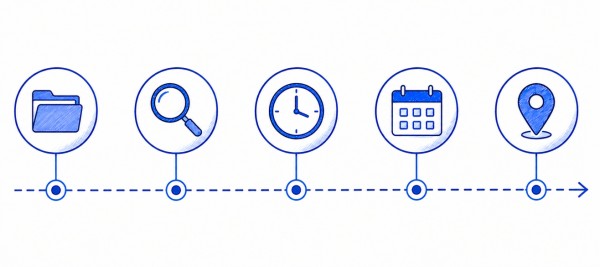
Timelines are essential for organizing complex data and identifying gaps. Chronological order helps you see relationships between events, such as registration dates and domain changes. If you notice a multi-month gap in activity, that anomaly warrants closer inspection. Let us examine a fictional timeline showing how individual actions connect over several weeks:
- January 15, 2026: An unknown user registers the domain example-pay.com.
- January 18, 2026: A GitHub user uploads a configuration file containing the example-pay.com domain.
- February 02, 2026: The example-pay.com domain points to a new IP address hosted in a different country.
- February 10, 2026: A local news article reports that a digital payment startup in that country went offline unexpectedly.
- February 12, 2026: The example-pay.com domain is put up for sale on a domain auction site.
This chronological view simplifies the investigation, showing how domain registration linked to a code commit and a host migration. Organizing details this way helps you quickly identify patterns of life and infrastructure changes.
Step 6: Write an Investigation Report
Your investigation is only as good as your final report. A professional report must be structured, objective, and based entirely on verifiable facts. It begins with your objective and methodology before presenting structured evidence with archived links. You must also document limitations—such as registry outages—and avoid personal opinions.
Common OSINT Tools
To conduct a digital investigation, you must understand standard tool categories. Investigators use search engines and Google Dorks for web queries, WHOIS databases and DNS lookup services for domains, and passive scanners like Shodan to inspect servers. You can explore a detailed breakdown of the Top 7 OSINT Tools in 2026 to see these utilities in action. Social media search, web archives, corporate records, and mapping tools are also essential for tracing links.
Source Verification Checklist
Before finalizing your report, verify findings using our standard checklist. Cross-validate information across two sources, analyze timestamps for temporal relevance, confirm the authority of registries, preserve screenshots, and ensure all steps are reproducible.
What Mistakes Should Beginners Avoid?
Learning OSINT is a process of trial and error, but avoiding these common pitfalls will save you time. Let us examine the most frequent errors to keep your data clean.
- Trusting a single source: Databases can be outdated, so always verify findings with a second source.
- Making assumptions: Do not assume identical names belong to the same person without unique identifiers.
- Ignoring dates: Check timestamps, as hosting IPs and registrations change over time.
- Poor documentation: Keep a detailed log of every search query and URL to ensure reproducibility.
- Not saving screenshots: Archive pages and take screenshots immediately, as target profiles can disappear.
- Mixing facts with opinions: Exclude speculation from reports and rely solely on verifiable evidence.
- Skipping verification: Cross-reference all findings, even if they align perfectly with your theory.
- Breaking website terms of service: Avoid aggressive automated scraping that triggers IP blocks or website violations.
Recommended Free OSINT Tools
Many OSINT tools exist, but you only need a few reliable utilities to start. The table below lists the most popular free tools used by professional investigators.
| Tool | Purpose | Free Version Available |
|---|
| Google Search | General web search and advanced filters | Yes |
| Wayback Machine | Viewing historical website snapshots | Yes |
| Shodan | Finding internet-connected devices | Yes (with limits) |
| Censys | Analyzing SSL certificates | Yes (with limits) |
| WHOIS | Checking domain registration details | Yes |
| DNSDumpster | Mapping domain infrastructure | Yes |
| Hunter.io | Finding corporate email addresses | Yes (with limits) |
| TinEye | Reverse image searching | Yes |
| IntelX | Searching historical data leaks | Yes (with limits) |
| CyberChef | Decoding and formatting data | Yes |
| OpenCorporates | Searching company registries | Yes |
| Flightradar24 | Tracking flight paths | Yes |
What Are Examples of OSINT Investigations?
OSINT is utilized across multiple industries to uncover facts and trace complex global operations. For training, you can read case studies like the Lazarus Group dream job scenario or the Viper Ghost threat actor analysis. To see this workflow applied to a real maritime incident, explore this detailed case study on the Smyrtos tanker sanctions seizure.
This case study demonstrates how analysts combined transponder records, satellite imagery, and corporate registers to track a sanctions-evading vessel. It provides a highly practical blueprint for conducting digital investigations.
FAQ: Frequently Asked Questions
Review these frequently asked questions to understand the legal, practical, and technical aspects of open-source investigations. This section addresses common queries from security beginners and SEO professionals.
1. What is an OSINT investigation?
An OSINT investigation involves collecting, verifying, and analyzing public data to answer a specific question. It relies entirely on open sources like public registries and search indexes.
2. Is OSINT legal?
Yes, OSINT is generally legal worldwide because it relies on publicly available information that does not require bypassing security controls. However, international laws vary, and investigations must comply with local privacy regulations and target platform terms of service.
3. What is the difference between OSINT and cyber hacking?
OSINT gathers publicly visible data ethically without exploiting systems. Hacking involves unauthorized access or exploiting software vulnerabilities, separating legal research from illegal intrusion.
4. Which OSINT tools are best for beginners?
Beginners should start with Google Search, WHOIS directories, DNSDumpster, and the Wayback Machine. These tools are free and require no coding skills.
5. How do investigators verify OSINT information?
Investigators cross-reference findings using at least two independent sources. Checking government registries and temporal records prevents confirmation bias and verification errors.
6. Can OSINT be used for cybersecurity?
Yes, cybersecurity teams use OSINT for passive reconnaissance. Identifying exposed assets before attackers do helps secure organization footprints.
About the Author
Abhiney Sharma is a cybersecurity researcher, OSINT practitioner, and the founder of VisualNotes.tech, where he publishes handwritten study guides on cloud, networking, and digital investigations. You can connect with him and follow his latest threat intelligence work on LinkedIn.
Final Thoughts
Conducting a successful OSINT investigation requires patience, attention to detail, and a structured approach. By defining your objective, collecting data passively, verifying findings, and correlating evidence, you can solve complex cases. As you practice, always respect privacy, local laws, and ethical boundaries. Building clean timelines and writing objective reports will naturally improve your investigative skills.