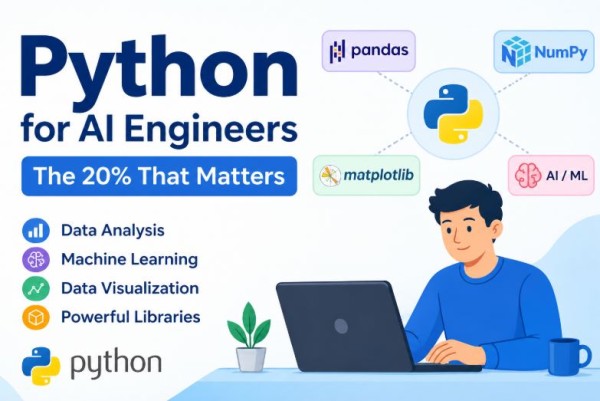
Artificial Intelligence (AI) is transforming every industry, from healthcare and finance to cybersecurity and cloud computing. But before building intelligent AI applications, every aspiring AI Engineer needs one essential skill, Python programming.
Python is the most popular programming language for AI because of its simple syntax, powerful libraries, and massive community support. The Day 1 session of “Python for AI Engineers – The 20% That Matters” focuses on the core Python concepts that every beginner should master before moving to Machine Learning and Deep Learning.
Why Learn Python for AI?
Python has become the industry standard for Artificial Intelligence because it is:
- Easy to learn
- Beginner-friendly
- Supports AI, Machine Learning, and Data Science
- Has thousands of useful libraries
- Used by companies like Google, Microsoft, Meta, Netflix, and OpenAI
Learning Python first allows you to focus on solving AI problems rather than struggling with complicated programming syntax.
Learning Objectives
The first session introduces four major learning goals:
- Explore Python
- Understand core concepts
- Execute Python programs
- Build confidence through practice
These objectives create a strong foundation for future AI development.
Setting Up Python
Before writing code, Python needs to be installed along with its packages.
Using the following command installs Python libraries:
pip install package_name
The presentation introduces the pip install command, which is the standard package manager for Python.
Understanding Python Data Types
Everything in Python is an object, and data is stored using different data types.
The session introduces five important data types:
- Numbers
- Strings
- Lists
- Tuples
- Dictionaries
1. Numbers
Numbers include integers and floating-point values.
age = 20
price = 199.99
2. Strings
Strings store text.
name = “Rahul”
3. Lists
Lists are ordered collections that can be modified.
languages = [“Python”, “Java”, “C++”]
4. Tuples
Tuples are similar to lists but cannot be modified.
coordinates = (10, 20)
5. Dictionaries
Dictionaries store information as key-value pairs.
student = {
“name”: “Rahul”,
“course”: “AI”
}
Loops in Python
Loops automate repetitive tasks.
The presentation covers two types of loops:
For Loop
A for loop repeats a block of code for a fixed number of iterations.
Example:
for i in range(5):
print(i)
Output
0
1
2
3
4
While Loop
A while loop runs until a condition becomes false.
count = 1
while count <= 5:
print(count)
count += 1
Conditional Statements
Decision-making is one of the most important programming concepts.
Python supports:
Example:
marks = 75
if marks >= 90:
print("Excellent")
elif marks >= 60:
print("Passed")
else:
print("Try Again")
Functions in Python
Functions help us organize code into reusable blocks.
Instead of writing the same code repeatedly, we write it once inside a function and call it whenever needed. The session introduces the concept of functions and explains why they are useful.
Example:
def greet(name):
print("Hello", name)
greet("Shalini")
Example: Factorial Function
The presentation demonstrates a factorial function using a loop.
def factorial(n):
fact = 1
for i in range(1, n + 1):
fact = fact * i
return fact
print(factorial(5))
Output
120
This example reinforces loops, variables, and functions together.
Introduction to Pandas
After learning Python basics, students are introduced to Pandas, one of the most widely used libraries for data analysis.
Pandas provides fast and flexible tools to work with structured and labeled datasets.
Some commonly used Pandas functions include:
Function Purpose
pd.read_csv() Read CSV files
df.head() View first five rows
df.tail() View last five rows
df.info() Dataset summary
df.describe() Statistical overview
df.shape Rows and columns
df.columns Display column names
df.isnull() Find missing values
df.dropna() Remove missing values
df.fillna() Fill missing values
More advanced operations include selecting data with loc and iloc, sorting, grouping, merging, concatenating, renaming, and exporting data.
Introduction to NumPy
NumPy is another essential Python library used extensively in AI, Machine Learning, and scientific computing.
It provides high-performance arrays along with mathematical and statistical functions.
Common NumPy functions include:
- np.array()
- np.arange()
- np.shape()
- np.ndim()
- np.sum()
- np.mean()
- np.median()
- np.min()
- np.max()
- np.where()
- np.sort()
These functions form the backbone of numerical computation in AI.
Introduction to Matplotlib
Visualization is an important part of Data Science and AI.
The presentation introduces Matplotlib, a Python library used to create charts and graphs for data visualization. It enables developers to generate 2D plots and explore datasets effectively.
Example:
import matplotlib.pyplot as plt
plt.plot([1,2,3],[2,4,6])
plt.show()
Python Interview Question
The Day 1 session concludes with a classic Python interview question involving mutable default arguments.
def append_item(item, lst=[]):
lst.append(item)
return lst
print(append_item(1))
print(append_item(2))
print(append_item(3))
Stay Tuned For Next Blog😉