If you still think your corporate network perimeter can protect your data, you are operating on borrowed time. Relying on traditional firewall boundaries is no longer a viable strategy when modern network perimeters simply do not exist.
Cyberattacks are advancing rapidly, and relying on outdated implicit trust creates major structural vulnerabilities. Recent security industry data shows that 65% of organizations have experienced a cyber breach specifically due to inadequate access controls. This glaring vulnerability is precisely why the security landscape is shifting away from outdated defense frameworks.
Adopting a Zero Trust framework ensures your business treats every single access attempt as a potential threat. By continuously verifying identities and devices, you can securely protect your critical digital infrastructure from modern cyber risks.
What Is Zero Trust?
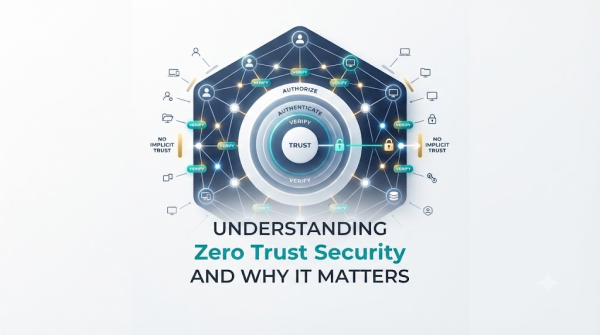
Zero Trust security is a modern cybersecurity framework built on a simple premise. You cannot automatically trust anything inside or outside your corporate network. Every access request must be fully verified and authenticated before anyone gains entry to your systems.
This strategy completely eliminates the old concept of a secure perimeter. Instead of assuming identity based on network location, it constantly validates every user and device. It treats all traffic as a potential threat, which drastically reduces your digital attack surface.
Recent data shows that over seventy percent of organizations are actively implementing these architectures today. By continuously verifying permissions, businesses can secure sensitive data, protect cloud environments, and stop unauthorized lateral movement across their internal networks effectively.
Why is Zero Trust Security Important?
Zero Trust security is essential for modern business stability because it systematically minimizes the financial and operational risks associated with sophisticated corporate data breaches.
Comprehensive Visibility Across Networks
Legacy systems often leave blind spots regarding who accesses specific company assets. A Zero Trust framework provides deep visibility by tracking every user, device, and application attempt. This continuous tracking helps your security team spot unusual behavior and isolate threats before they can cause major operational damage.
Mitigation of Insider Threats
Many data breaches actually originate from compromised internal credentials or malicious employees. Since this model never assumes trust based on location, it restricts internal lateral movement. Every internal request requires strict authentication, ensuring that unauthorized users cannot freely roam through your sensitive systems.
Protection for Remote Workforces
Modern businesses operate far beyond a single physical office building. Remote employees access critical corporate applications from various external networks and personal devices daily. Implementing strict verification policies ensures secure connection points, protecting your corporate cloud assets regardless of where your team logs in.
Prevention of Modern Cyberattacks
Cybercriminals constantly deploy advanced tactics like ransomware and sophisticated phishing schemes to steal valuable corporate data. This architecture stops these attacks by verifying data requests at every single stage. It prevents malicious code from expanding across your broader infrastructure, saving your business from costly downtime.
Simplified Regulatory Compliance
Meeting strict data protection regulations like GDPR or HIPAA can be incredibly complex. This security model simplifies compliance by maintaining detailed access logs and enforcing strict data controls. You can easily prove to industry regulators that your company actively monitors and protects consumer information.
What are the Core Principles of the Zero Trust Model?
Zero Trust is built on a simple idea: never automatically trust any user, device, or application. Instead, every access request is continuously verified based on identity, context, risk, and security policies before access is granted.
1. Verify Every User and Device
Every user and device must be authenticated and validated before accessing systems, applications, or data. Zero Trust assumes that threats can exist both inside and outside the network. Continuous identity verification, device health checks, and access validation help reduce the risk of unauthorized access.
2. Enforce Least Privilege Access
Users should only receive the minimum level of access required to perform their tasks. Limiting permissions reduces the attack surface and prevents attackers from moving freely if an account becomes compromised. Access rights should be reviewed and adjusted regularly based on business needs.
3. Assume Breach and Minimize Impact
Zero Trust operates with the assumption that a security breach can occur at any time. Organizations should focus on limiting damage through segmentation, continuous monitoring, and rapid threat detection. This approach helps contain security incidents before they spread across critical systems.
4. Continuously Monitor and Validate Activity
Trust is never permanent in a Zero Trust environment. User behavior, device status, application activity, and network traffic are continuously monitored for suspicious actions. Real-time visibility allows security teams to detect anomalies quickly and respond before threats escalate.
5. Protect Data Across All Environments
Data protection remains a core principle of Zero Trust security. Sensitive information should be secured whether it is stored, shared, or accessed across cloud environments, applications, endpoints, and networks. Encryption, access controls, and data security policies help maintain confidentiality and integrity.
What are the Benefits of a Zero Trust Architecture?
Adopting a Zero Trust architecture provides businesses with measurable operational benefits by significantly reducing their attack surface and modernizing data protection standards.
- Enhanced Data Protection: Continuous validation strategies safeguard sensitive corporate data by verifying every access request instantly, lowering the risk of accidental information leaks.
- Minimized Attack Surface: Microsegmentation restricts lateral network movement, which successfully confines potential security threats and keeps unauthorized users away from critical infrastructure.
- Seamless Remote Security: Strong identity verification policies secure distributed workforces, allowing remote employees to connect safely from any external network or device.
- Streamlined Regulatory Compliance: Detailed access logging helps your IT team satisfy complex auditing requirements for frameworks like GDPR, HIPAA, and PCI-DSS.
- Optimized Threat Visibility: Real-time telemetry tracking gives security teams total clarity over network activity, allowing them to spot and isolate anomalies quickly.
How to Implement Zero Trust Architecture: Simplified Strategy
Implementing a Zero Trust architecture requires a systematic strategy focused on securing corporate data, verifying user identities, and protecting critical infrastructure through continuous network monitoring and access controls.
Step 1: Identify Your Critical Digital Assets
Before changing policies, you must map your entire corporate ecosystem. Locate where your sensitive data lives, identify which applications power your daily business operations, and list all hardware connected to your network. Knowing exactly what you need to protect allows your IT team to build accurate defense boundaries around your most valuable digital resources.
Step 2: Implement Strong Identity and Access Management
Verify every person and device attempting to enter your corporate network. Deploy robust multi-factor authentication policies and single sign-on solutions across all departments. This step ensures that user identity is constantly validated, preventing hackers from using stolen employee credentials to access private company applications or sensitive consumer records.
Step 3: Enforce Strict Least Privilege Access Policies
Limit user permissions so employees only look at information required for their specific jobs. Restricting broad access rights prevents everyday users from changing critical system settings or viewing restricted financial files. This policy dramatically lowers your internal security risks and keeps unauthorized personnel away from proprietary data.
Step 4: Divide the Network Using Microsegmentation
Break your corporate network infrastructure down into smaller, isolated zones. By creating secure virtual walls around individual workloads, you stop threats from moving sideways if a breach occurs. If an attacker compromises one employee account, the damage remains contained within that single zone, protecting the rest of your business.
Step 5: Establish Continuous Monitoring and Analytics
Deploy automated tools to watch your entire digital infrastructure in real time. Constantly tracking network telemetry helps security teams spot unusual behaviors or unauthorized access attempts immediately. This continuous visibility allows your business to respond to potential cyber threats fast, minimizing downtime and safeguarding corporate assets.
Wrapping Up
Zero Trust Security is no longer an optional security approach for modern organizations. As users, applications, and data move beyond traditional network boundaries, continuous verification has become essential for reducing risk and maintaining control.
At its core, Zero Trust replaces assumptions with validation. Every user, device, and access request must be verified before access is granted. This helps organizations strengthen security, limit unauthorized access, and reduce the impact of potential breaches.
Implementing Zero Trust is an ongoing process rather than a one-time project. Organizations that continuously monitor access, enforce least privilege, and adapt to evolving threats are better positioned to protect critical systems, sensitive data, and business operations.