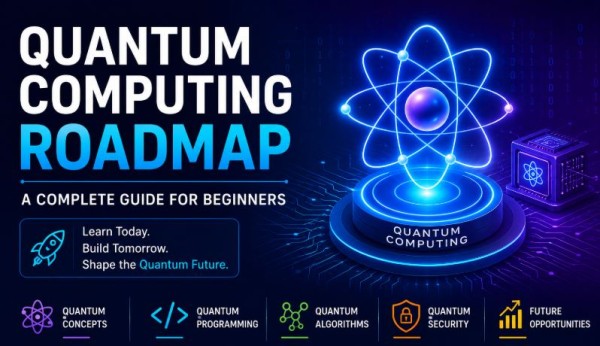
Quantum Computing is one of the most exciting technologies shaping the future of computing. While classical computers have powered the digital world for decades, quantum computers promise to solve problems that are nearly impossible for traditional machines.
Major technology companies such as IBM, Google, Microsoft, Amazon, and Intel are investing heavily in quantum research. Governments and universities worldwide are also accelerating quantum innovation, making it an excellent time to start learning this field.
If you’re wondering “How do I learn Quantum Computing?”, this roadmap will guide you step by step—from basic concepts to advanced topics.
What is Quantum Computing?
Quantum Computing is a new type of computing that uses the principles of quantum mechanics to process information.
Unlike classical computers that use bits (0 or 1), quantum computers use qubits, which can exist in multiple states simultaneously.
This allows quantum computers to solve certain complex problems much faster than traditional computers.
Why Learn Quantum Computing?
Quantum Computing has applications in many industries, including:
- Cybersecurity
- Artificial Intelligence
- Drug Discovery
- Financial Modeling
- Cryptography
- Logistics
- Material Science
- Climate Research
- Optimization Problems
As the technology matures, professionals with quantum computing knowledge will be in high demand.
Quantum Computing Learning Roadmap
Let’s explore the roadmap step by step.
Step 1: Build Strong Programming Skills
Before learning Quantum Computing, you should be comfortable with programming.
The most commonly used language is Python because most quantum frameworks are built around it.
Learn topics such as:
- Variables
- Loops
- Functions
- Object-Oriented Programming
- NumPy
- Matplotlib
- Basic Data Structures
Recommended Duration:
2–4 weeks
Step 2: Learn Basic Mathematics
Quantum Computing relies heavily on mathematics.
Important topics include:
- Linear Algebra
- Matrices
- Vectors
- Complex Numbers
- Probability
- Basic Calculus
You don’t need to master advanced mathematics immediately, but understanding these concepts will make learning much easier.
Recommended Duration:
4–6 weeks
Step 3: Understand Quantum Mechanics Basics
Quantum Computing is built on quantum physics.
Focus on understanding concepts such as:
- Wave Functions
- Superposition
- Entanglement
- Quantum Measurement
- Probability Amplitudes
- Quantum States
Don’t worry if the physics feels challenging at first—focus on developing an intuitive understanding.
Step 4: Learn Qubits
A qubit is the basic unit of information in Quantum Computing.
Unlike a classical bit, a qubit can represent multiple possibilities simultaneously until it is measured.
Topics to study include:
- Qubit Representation
- Bloch Sphere
- Quantum States
- Measurement
- Quantum Register
Step 5: Learn Quantum Gates
Quantum Gates manipulate qubits, similar to how logic gates operate in classical computing.
Common quantum gates include:
- Pauli-X Gate
- Pauli-Y Gate
- Pauli-Z Gate
- Hadamard Gate
- CNOT Gate
- SWAP Gate
Understanding these gates is essential for building quantum circuits.
Step 6: Learn Quantum Circuits
Quantum algorithms are built using quantum circuits.
Study concepts such as:
- Circuit Design
- Measurement Operations
- Multi-Qubit Systems
- Controlled Gates
- Circuit Optimization
Once you understand circuits, you can begin implementing simple quantum programs.
Step 7: Learn Quantum Algorithms
Quantum algorithms demonstrate the true power of quantum computers.
Important algorithms include:
- Deutsch-Jozsa Algorithm
- Grover’s Search Algorithm
- Shor’s Algorithm
- Quantum Fourier Transform (QFT)
- Quantum Phase Estimation
These algorithms are frequently discussed in quantum computing interviews and research.
Step 8: Learn Quantum Programming
After understanding the fundamentals, start writing quantum programs.
Popular frameworks include:
- IBM Qiskit
- Google Cirq
- PennyLane
- Amazon Braket SDK
These tools allow developers to simulate quantum circuits and, in some cases, run them on real quantum hardware.
Step 9: Practice on Quantum Simulators
You don’t need expensive hardware to learn Quantum Computing.
Most frameworks provide simulators where you can:
- Create quantum circuits
- Execute algorithms
- Debug programs
- Visualize quantum states
Once you’re comfortable, you can experiment with cloud-based quantum computers.
Step 10: Learn Quantum Machine Learning
Quantum Machine Learning (QML) combines AI with quantum computing.
Topics include:
- Quantum Neural Networks
- Quantum Feature Maps
- Variational Quantum Circuits
- Hybrid Classical-Quantum Models
This area is rapidly growing and offers exciting research opportunities.
Step 11: Understand Quantum Cryptography
Quantum Computing has significant implications for cybersecurity.
Key topics include:
- Quantum Key Distribution (QKD)
- Post-Quantum Cryptography
- Quantum Random Number Generation
- Quantum-safe Encryption
Security professionals should understand how quantum technologies may impact modern cryptographic systems.
Step 12: Explore Real-World Applications
Quantum Computing is already being explored in:
- Drug Discovery
- Supply Chain Optimization
- Portfolio Optimization
- Weather Prediction
- Material Science
- Artificial Intelligence
- Cybersecurity
- Traffic Optimization
Studying these applications helps connect theory with practical use cases.
Tools Every Beginner Should Learn
As you progress, become familiar with:
- Python
- Jupyter Notebook
- IBM Qiskit
- Google Cirq
- PennyLane
- Amazon Braket
- NumPy
- Matplotlib
- Git & GitHub
These tools form the foundation of many quantum development workflows.
Common Challenges Beginners Face
Learning Quantum Computing can feel overwhelming because it combines computer science, mathematics, and physics.
Some common challenges include:
- Understanding quantum mechanics
- Learning linear algebra
- Visualizing qubit behavior
- Debugging quantum circuits
- Finding practical projects
The key is to learn gradually and practice consistently.
Career Opportunities
As Quantum Computing continues to evolve, professionals may find opportunities such as:
- Quantum Software Developer
- Quantum Research Engineer
- Quantum Algorithm Developer
- Quantum Machine Learning Engineer
- Quantum Security Researcher
- Quantum Hardware Engineer
- Research Scientist
- Quantum Consultant
Demand is expected to grow as more industries adopt quantum technologies.
Best Learning Tips
To build a strong foundation:
- Master Python first.
- Learn the mathematics step by step.
- Practice with quantum simulators.
- Build small quantum projects.
- Read research papers and technical blogs.
- Join quantum computing communities.
- Participate in hackathons and workshops.
- Stay updated with the latest developments.
Consistency is more important than speed.
The Future of Quantum Computing
Quantum Computing is still an emerging field, but progress is accelerating.
Future developments may include:
- More powerful quantum processors
- Better error correction
- Practical quantum applications
- Quantum cloud services
- Quantum-enhanced AI
- Quantum-safe cybersecurity solutions
While classical computers will continue to dominate many tasks, quantum systems are expected to complement them in solving highly complex problems.