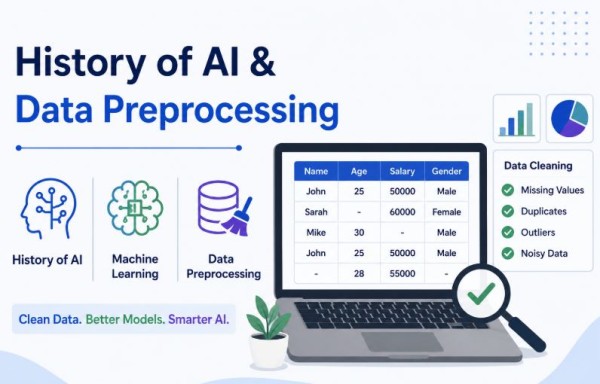
Artificial Intelligence (AI) has transformed from a theoretical concept into one of the most revolutionary technologies of the 21st century. From self-driving cars and virtual assistants to medical diagnosis and cybersecurity, AI is shaping the future. However, behind every successful AI model lies another equally important process.
In this guide, we’ll explore the evolution of Artificial Intelligence, understand the fundamentals of Machine Learning, and learn why clean, high-quality data is the key to building accurate AI models. These concepts form the core in the AI Engineer learning journey.
The Evolution of Artificial Intelligence
Artificial Intelligence has evolved through several major phases over the past seven decades.
1. The Birth of AI (1950–1974)
The journey of AI officially began in the 1950s with groundbreaking ideas that shaped the future of intelligent machines.
British mathematician Alan Turing proposed the famous Turing Test, which evaluates whether a machine can imitate human intelligence well enough that a person cannot distinguish it from another human.
- Dartmouth Conference (1956)
In 1956, computer scientist John McCarthy organized the Dartmouth Conference, where the term Artificial Intelligence was officially introduced.
During the same period, Allen Newell and Herbert Simon developed the Logic Theorist, considered one of the world’s first AI programs capable of solving mathematical theorems.
These milestones marked the beginning of AI as an academic and research field.
The First AI Winter (1974–1980)
The early excitement around AI eventually slowed due to unrealistic expectations.
Major reasons included:
- AI systems failed to deliver expected results.
- Governments and organizations reduced research funding.
This period became known as the First AI Winter.
The Rise of Machine Learning (1990s–2010)
AI gained momentum again with two major developments:
- Availability of massive amounts of digital data
- Significant improvements in computing power
Instead of programming machines with explicit rules, researchers began teaching computers to learn patterns directly from data. This shift gave birth to modern Machine Learning.
The Deep Learning Revolution (2010–Present)
The last decade has been the most exciting era in AI history.
AlphaGo (2016)
Google DeepMind’s AlphaGo defeated the world champion in the complex board game Go, proving that deep learning could solve problems previously considered impossible for machines.
ChatGPT (2022)
The launch of ChatGPT introduced Large Language Models (LLMs) to millions of users worldwide. It demonstrated how AI could understand natural language, answer questions, generate content, and assist in everyday tasks, bringing AI into the mainstream.
What is Machine Learning?
Machine Learning is a branch of Artificial Intelligence that enables computers to learn patterns from data instead of being explicitly programmed.
Rather than following fixed rules, Machine Learning models improve their predictions by learning from examples.
Types of Machine Learning
Machine Learning is generally divided into three categories:
- Supervised Learning
- Unsupervised Learning
- Semi-Supervised Learning
1. Supervised Learning
In supervised learning, the training data already contains correct labels.
For example:
Image Label
🍎 Apple
🍌 Banana
The model learns the relationship between inputs and outputs so it can classify new data accurately. The presentation illustrates this using labeled apple and banana examples.
Common applications include:
- Spam email detection
- Disease prediction
- Face recognition
- Credit risk analysis
2. Unsupervised Learning
In unsupervised learning, data has no labels.
The algorithm discovers hidden patterns, similarities, or clusters automatically.
Applications include:
- Customer segmentation
- Market basket analysis
- Recommendation systems
- Fraud detection
3. Semi-Supervised Learning
Semi-supervised learning combines a small amount of labeled data with a large amount of unlabeled data.
It is commonly used when labeling data is expensive or time-consuming.
Examples include:
- Medical image analysis
- Speech recognition
- AI-powered search engines
The Machine Learning Pipeline
Building a Machine Learning model involves several important stages:
- Data Collection
- Data Preprocessing
- Feature Engineering
- Model Training
- Model Evaluation
- Deployment
The process is iterative, meaning models are continuously improved using feedback and new data.
What is Data Preprocessing?
Raw data collected from the real world is rarely clean.
It often contains:
- Missing values
- Duplicate records
- Incorrect information
- Noise
- Outliers
Data Preprocessing is the process of cleaning, transforming, and organizing data before it is used for Machine Learning.
Its primary goals are:
- Improve data quality
- Remove errors
- Handle inconsistencies
- Prepare data for Machine Learning algorithms
Without proper preprocessing, even the best AI model can produce poor results.
Common Data Quality Problems
1. Missing Data
Sometimes values are unavailable.
Example:
Age = NULL
Missing values may occur due to incomplete surveys, system failures, or human error.
2. Duplicate Data
Duplicate records can bias Machine Learning models.
Example:
John,25
John,25
Duplicates should be detected and removed before training.
3. Noisy Data
Noisy data contains incorrect or impossible values.
Example:
Salary = -50000
4. Outliers
Outliers are unusually large or small values that differ significantly from the rest of the dataset.
Example:
Salary = 10,000,000
Outliers can distort statistical analysis and Machine Learning predictions.
Handling Missing Values
There are several strategies for dealing with missing data.
Delete Missing Records
df.dropna()
This removes rows containing missing values.
Fill Missing Values with Mean
Suitable for normally distributed numerical data.
df["Age"].fillna(df["Age"].mean())
Fill Missing Values with Median
Useful when the dataset contains outliers.
df[“Age”].fillna(df[“Age”].median())
Fill Missing Values with Mode
Best suited for categorical data.
df["Gender"].fillna(df["Gender"].mode()[0])
Handling Duplicate Data
Pandas provides simple methods to identify and remove duplicate records.
Detect Duplicates
df.duplicated()
Remove Duplicates
df.drop_duplicates()
Removing duplicates improves data quality and prevents models from learning the same information multiple times.
Detecting Outliers Using IQR
One of the most common methods for detecting outliers is the Interquartile Range (IQR).
The formulas are:
IQR = Q3 - Q1
Lower Bound = Q1 - 1.5 × IQR
Upper Bound = Q3 + 1.5 × IQR
Values outside these boundaries are generally treated as outliers.
Stay Tuned For Next Blog.