Blue Box: Ghost Process - Incident Response Writeup Report
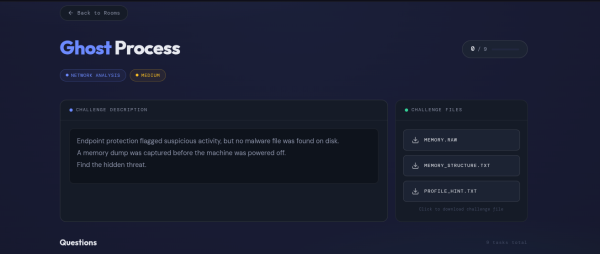
Case ID: BlueCorp-IR-2026-0730
Classification: Confirmed Compromise - Process Injection & C2 Beaconing
Analyst: Security Operations
Evidence: memory.raw (Windows 10 Enterprise, Build 19041, x64)
Date of Analysis: 2026-07-30
Challenge Link: https://learn.hacklido.com/blue-box/ghost-process
1. Executive Summary
A memory dump captured from a BlueCorp Windows 10 workstation was analyzed to determine whether the host was compromised. Analysis of the process tree and memory regions confirms a phishing-driven infection chain: a malicious Word document opened via Outlook spawned PowerShell, which injected shellcode into a legitimate svchost.exe process. The injected code establishes beaconing communication to two external C2 servers.
Verdict: Host is compromised. Process injection and active C2 configuration confirmed in memory.
2. Tools Used
| Tool | Purpose |
|---|
| Volatility 2 / 3 | Process listing, tree reconstruction, malfind, memory region analysis |
| Manual string analysis | Extraction of embedded C2 configuration from injected memory region |
Recommended profile (from profile_hint.txt): Win10x64_19041 (Volatility 2), or native symbol table auto-detection (Volatility 3).
3. Methodology - Step by Step
Step 1: Identify the OS profile
volatility -f memory.raw imageinfo
Confirmed from the provided profile hint:
System: Windows 10 Enterprise
Build: 19041
Architecture: x64
Recommended Profile: Win10x64_19041
Step 2: Enumerate running processes and reconstruct the process tree
volatility -f memory.raw --profile=Win10x64_19041 pstree
Volatility 3 equivalent:
volatility -f memory.raw windows.pstree.PsTree
Relevant branch of the tree (PPID chain reconstructed from the process list):
explorer.exe (1712)
OUTLOOK.EXE (2416) started 12:00:00
WINWORD.EXE (2528) started 14:23:00
powershell.exe (2644) started 14:23:05
schtasks.exe (2752) started 14:23:45
WINWORD.EXE spawning powershell.exe is abnormal. Microsoft Word does not legitimately launch PowerShell as a child process during normal document editing. This pattern is the standard signature of a malicious macro embedded in a document delivered as an email attachment (opened through Outlook), which then executes PowerShell to stage further compromise. The subsequent schtasks.exe child process is consistent with the attacker establishing scheduled-task persistence.
Timeline correlation also supports this: OUTLOOK.EXE had been running since 12:00:00, but WINWORD.EXE was not opened until 14:23:00, immediately followed by powershell.exe five seconds later, then schtasks.exe forty seconds after that. This tight sequence of events is consistent with a user opening a malicious attachment and the macro executing automatically.
Q1 - Suspicious parent-child relationship: HackCTF{WINWORD.EXE_POWERSHELL.EXE}
Step 3: Hunt for code injection with malfind
volatility -f memory.raw --profile=Win10x64_19041 malfind
Volatility 3 equivalent:
volatility -f memory.raw windows.malfind.Malfind
malfind flags processes containing memory regions that are both executable and writable, and that lack a backing file on disk, a strong indicator of injected shellcode. The suspicious activity log confirms this finding directly:
Injected Process PID: 720 (svchost.exe)
Injected by PID: 604 (via powershell.exe)
Injection Time: 2024-03-15 14:23:08
svchost.exe (PID 720) is a legitimate Windows service host process, but legitimate svchost.exe instances should never contain freshly allocated RWX memory regions with no associated module or file. This is classic process hollowing / remote thread injection behavior, where malware injects its payload into a trusted system process to evade detection.
The injection timestamp (14:23:08) falls three seconds after powershell.exe was spawned (14:23:05) from the WINWORD.EXE chain identified in Step 2, tying the injection directly back to the phishing execution chain.
Q2 - Process showing signs of injection: HackCTF{SVCHOST.EXE}
Q3 - PID of the injected process: HackCTF{720}
Q4 - Process that performed the injection: HackCTF{POWERSHELL.EXE}
Step 4: Examine the injected memory region
volatility -f memory.raw --profile=Win10x64_19041 vadinfo -p 720
Volatility 3 equivalent:
volatility -f memory.raw windows.vadinfo.VadInfo --pid 720
The memory region table for PID 720 shows:
PID: 720 Start: 0x7ffa0000 Size: 245760 Protection: EXECUTE_READWRITE
PID: 720 Start: 0x7ffb5000 Size: 4096 Protection: READWRITE
The first region carries PAGE_EXECUTE_READWRITE protection, meaning the memory can be written to and executed simultaneously. Legitimate code pages are normally either read-only executable (loaded from a signed module) or read-write non-executable (heap/data). A combined RWX region is a hallmark of injected shellcode that has been written into memory and is being executed directly, without ever touching disk as a standalone file.
Q5 - Memory protection used for the injected code: HackCTF{EXECUTE_READWRITE}
Q6 - Base address of the injected code: HackCTF{0x7ffa0000}
Q7 - Size of the injected payload: HackCTF{245760}
Step 5: Extract embedded C2 configuration strings
volatility -f memory.raw --profile=Win10x64_19041 yarascan -p 720 -Y "C2_IP|C2_PORT"
Or extract raw strings from the identified VAD region directly:
volatility -f memory.raw --profile=Win10x64_19041 memdump -p 720 -D ./dump/
strings ./dump/720.dmp | grep -E "C2_|BEACON|USER_AGENT"
The second (smaller) memory region at 0x7ffb5000 contains the malware’s embedded configuration block, decoded directly from the dump:
C2_IP=185.142.53.122
C2_PORT=8080
ENCRYPTION_KEY=0xAB12CD34EF56
USER_AGENT=Mozilla/5.0 (Windows NT 10.0; Win64; x64)
BEACON_INTERVAL=60
JITTER=20
This is corroborated by the separate C2 communication summary in the dump analysis:
Primary C2: 185.142.53.122:8080
Secondary C2: 45.155.205.33:8443
The malware beacons out to its primary C2 on a 60-second interval with 20-second jitter (to avoid predictable, easily-signatured network patterns), using a spoofed browser User-Agent to blend traffic with normal web activity, and an XOR-style key for encrypting its C2 traffic.
Q8 - C2 IP embedded in the payload: HackCTF{185.142.53.122}
Q9 - Port used for C2 communication: HackCTF{8080}
4. Consolidated Findings
| # | Question | Answer | Flag |
|---|
| 1 | Suspicious parent-child relationship | WINWORD.EXE spawning powershell.exe | HackCTF{WINWORD.EXE_POWERSHELL.EXE} |
| 2 | Process showing signs of injection | svchost.exe | HackCTF{SVCHOST.EXE} |
| 3 | PID of injected process | 720 | HackCTF{720} |
| 4 | Process that performed the injection | powershell.exe | HackCTF{POWERSHELL.EXE} |
| 5 | Memory protection of injected code | EXECUTE_READWRITE | HackCTF{EXECUTE_READWRITE} |
| 6 | Base address of injected code | 0×7ffa0000 | HackCTF{0x7ffa0000} |
| 7 | Size of injected payload | 245760 bytes | HackCTF{245760} |
| 8 | C2 IP embedded in payload | 185.142.53.122 | HackCTF{185.142.53.122} |
| 9 | C2 port | 8080 | HackCTF{8080} |
5. Indicators of Compromise (IOCs)
- Parent process chain:
explorer.exe > OUTLOOK.EXE > WINWORD.EXE > powershell.exe > schtasks.exe
- Injected process:
svchost.exe (PID 720)
- Injecting process:
powershell.exe
- Injected region: base
0x7ffa0000, size 245760 bytes, protection PAGE_EXECUTE_READWRITE
- Primary C2:
185.142.53.122:8080
- Secondary C2:
45.155.205.33:8443
- Beacon interval: 60 seconds, jitter 20 seconds
- User-Agent:
Mozilla/5.0 (Windows NT 10.0; Win64; x64)
- Encryption key (embedded):
0xAB12CD34EF56
6. Recommendations
- Isolate the affected host from the network immediately.
- Block
185.142.53.122:8080 and 45.155.205.33:8443 at the perimeter firewall.
- Terminate the injected
svchost.exe process (PID 720) and any spawned scheduled tasks created by schtasks.exe.
- Review Outlook mail logs to identify the original phishing email and the malicious attachment, and remove it from all mailboxes.
- Audit scheduled tasks on the host for unauthorized persistence entries created around 2024-03-15 14:23:45.
- Disable or restrict macro execution for Office documents received via email, organization-wide, if not already enforced.
- Hunt across the environment for the same IOCs (C2 IPs, User-Agent, encryption key, beacon timing) to rule out lateral spread.