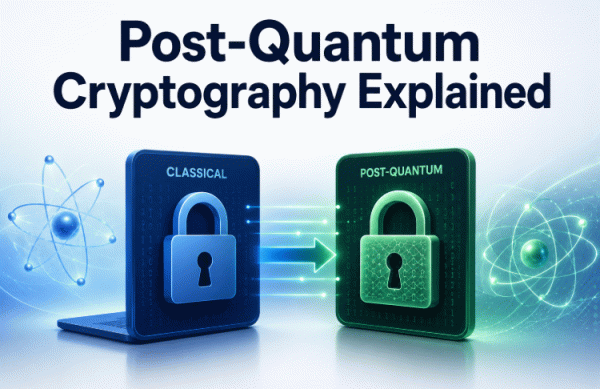
For decades, modern encryption has protected everything from online banking and messaging apps to cloud services and government systems. Technologies like RSA and Elliptic Curve Cryptography (ECC) have formed the backbone of internet security.
However, the rise of quantum computing introduces a new challenge. Powerful quantum computers could eventually solve mathematical problems that are considered practically impossible for today’s classical computers, making many current encryption methods vulnerable.
To address this challenge, cybersecurity experts are developing Post-Quantum Cryptography (PQC)—cryptographic algorithms designed to remain secure even against quantum computer attacks.
In this guide, you’ll learn what Post-Quantum Cryptography is, why it matters, how it works, and how organizations can prepare for a quantum-safe future.
What is Post-Quantum Cryptography?
Post-Quantum Cryptography (PQC) refers to cryptographic algorithms that are designed to resist attacks from both classical computers and quantum computers.
Unlike quantum cryptography, which relies on quantum physics for secure communication, PQC uses traditional computing systems while replacing vulnerable mathematical algorithms with quantum-resistant alternatives.
This means existing devices, servers, and applications can adopt PQC without requiring quantum hardware.
Why is Post-Quantum Cryptography Important?
Today’s internet security depends on encryption algorithms such as:
- RSA
- Elliptic Curve Cryptography (ECC)
- Diffie-Hellman Key Exchange
These algorithms are secure against current computers because factoring very large numbers or solving discrete logarithm problems is computationally difficult.
However, a sufficiently powerful quantum computer running Shor’s Algorithm could solve these problems much more efficiently, potentially breaking many of the public-key systems used today.
Although large-scale quantum computers capable of doing this are not yet widely available, organizations must prepare in advance because migrating cryptographic infrastructure takes years.
Classical Computing vs Quantum Computing
Traditional computers process information using bits, where each bit is either 0 or 1.
Quantum computers use qubits, which can represent multiple states through quantum properties such as superposition and entanglement.
This allows certain calculations to be performed much more efficiently than on classical computers.
While quantum computers will not replace classical computers for every task, they have the potential to dramatically impact cryptography.
Which Encryption Methods Are at Risk?
Quantum computers primarily threaten public-key cryptography.
Potentially affected algorithms include:
- RSA
- Diffie-Hellman
- Elliptic Curve Cryptography (ECC)
- Digital Signature Algorithms based on factoring or discrete logarithms
Symmetric encryption, such as AES, is considered more resistant to quantum attacks, although larger key sizes are recommended to maintain strong security.
What Makes an Algorithm Quantum-Resistant?
Post-Quantum Cryptography uses mathematical problems that are currently believed to remain difficult even for quantum computers.
Some of the major approaches include:
- Lattice-based cryptography
- Hash-based cryptography
- Code-based cryptography
- Multivariate polynomial cryptography
- Isogeny-based cryptography (an area of ongoing research)
These mathematical foundations provide the basis for quantum-resistant encryption and digital signatures.
NIST and the Standardization of PQC
To prepare for the future, the National Institute of Standards and Technology (NIST) launched an international effort to evaluate and standardize post-quantum algorithms.
Several algorithms have been selected for standardization because of their strong security and practical performance.
These standards will guide governments, software vendors, cloud providers, and enterprises as they transition to quantum-resistant cryptography.
Where Will Post-Quantum Cryptography Be Used?
PQC will play an important role in securing:
- HTTPS websites
- VPN connections
- Cloud services
- Mobile applications
- Email encryption
- Financial systems
- Government communications
- Healthcare platforms
- Internet of Things (IoT) devices
- Digital signatures
- Software updates
As organizations upgrade their infrastructure, these technologies will gradually incorporate quantum-resistant algorithms.
Challenges of Adopting PQC
Although PQC offers strong security, migration is not without challenges.
Some common issues include:
Larger Key Sizes
Many quantum-resistant algorithms require larger public keys or signatures than traditional cryptographic systems.
Performance Considerations
Some algorithms may increase computational overhead, requiring optimization for large-scale deployments.
Compatibility
Existing applications and protocols need updates to support new cryptographic standards.
Long-Term Planning
Organizations often manage systems with long life cycles, making cryptographic migration a gradual process rather than an overnight change.
How Organizations Can Prepare
Organizations do not need to replace every encryption algorithm immediately, but they should begin preparing today.
Recommended steps include:
- Identify where cryptography is used.
- Inventory certificates, keys, and protocols.
- Monitor developments in PQC standards.
- Test quantum-resistant implementations.
- Plan phased migrations.
- Keep software and cryptographic libraries updated.
- Design systems with cryptographic agility so algorithms can be replaced more easily in the future.
Real-World Example
Imagine a financial institution using RSA to secure customer communications.
An attacker cannot decrypt the encrypted traffic today, but they may capture and store it.
Years later, if quantum computers become powerful enough, that attacker could potentially decrypt the archived communications if the encryption relied solely on vulnerable public-key algorithms.
This concept is often referred to as “Harvest Now, Decrypt Later.”
Migrating to quantum-resistant encryption helps reduce this long-term risk.
Best Practices for a Quantum-Safe Future
To strengthen long-term security:
- Use strong symmetric encryption such as modern AES implementations.
- Follow NIST-recommended PQC standards as they become available.
- Keep cryptographic libraries updated.
- Regularly rotate encryption keys.
- Maintain an inventory of cryptographic assets.
- Enable cryptographic agility within applications.
- Test hybrid deployments during migration.
- Educate development and security teams about PQC.
Common Misconceptions
“Quantum computers have already broken RSA.”
Not yet. Current quantum computers are not capable of breaking widely deployed RSA at internet scale.
“We need quantum computers to use PQC.”
No. Post-Quantum Cryptography runs on today’s classical computers.
“All encryption becomes useless.”
No. Symmetric encryption remains comparatively resilient, though larger key sizes may be recommended.
“Migration can wait.”
Cryptographic transitions often take many years. Early planning reduces future risk.
The Future of Post-Quantum Cryptography
As quantum computing continues to evolve, Post-Quantum Cryptography will become a standard part of cybersecurity.
Future developments are likely to include:
- Quantum-safe web browsers
- Quantum-resistant VPNs
- Secure cloud infrastructure
- PQC-enabled IoT devices
- Quantum-safe digital identities
- Hybrid cryptographic protocols
- Enterprise-wide cryptographic agility
Organizations that begin preparing today will be better positioned for the next generation of secure digital communication.