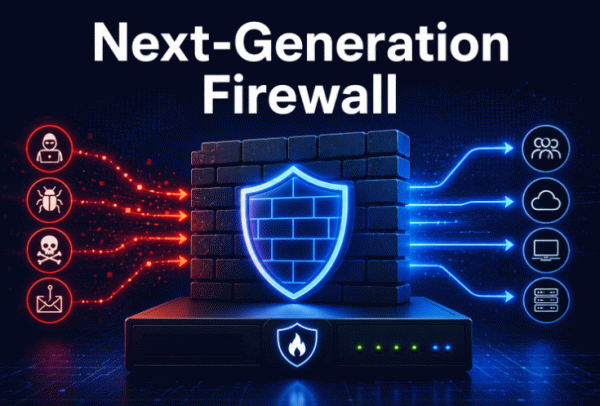
Every second, millions of cyberattacks target businesses, governments, and individuals. From malware and ransomware to phishing and unauthorized access attempts, modern cyber threats are becoming more advanced than ever.
A traditional firewall can block unwanted network traffic, but today’s attacks often require deeper inspection and intelligent threat detection. This is where a Next-Generation Firewall (NGFW) becomes essential.
An NGFW goes beyond basic traffic filtering by identifying applications, inspecting encrypted traffic, detecting malware, and preventing sophisticated cyberattacks.
In this beginner-friendly guide, we’ll explore what an NGFW is, how it works, its key features, and why it has become an essential part of modern cybersecurity.
What is a Firewall?
A firewall is a network security device or software that monitors and controls incoming and outgoing network traffic based on predefined security rules.
Its primary purpose is to act as a security barrier between trusted and untrusted networks.
For example:
- Allow employees to access company websites.
- Block unauthorized connections.
- Prevent malicious traffic from entering the network.
Firewalls have been protecting computer networks for decades.
What is a Next-Generation Firewall (NGFW)?
A Next-Generation Firewall (NGFW) is an advanced firewall that combines traditional firewall capabilities with modern security technologies.
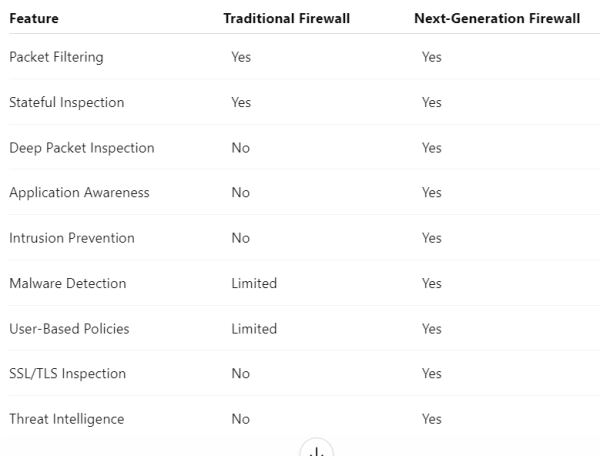
Unlike traditional firewalls that mainly inspect IP addresses and ports, NGFWs can understand applications, inspect encrypted traffic, identify users, and detect sophisticated attacks.
Think of it as a security guard that not only checks who is entering but also understands what they are carrying and whether their behavior is suspicious.
Why Do We Need an NGFW?
Modern cyberattacks no longer rely only on open ports.
Attackers now use:
- Encrypted communication
- Web applications
- Cloud services
- Remote access
- Social engineering
- Malware hidden inside legitimate traffic
Traditional firewalls often cannot detect these threats.
NGFWs provide deeper inspection and better visibility into network activity.
How Does an NGFW Work?
An NGFW analyzes network traffic in multiple stages.
- Traffic enters the firewall.
- Basic firewall rules are applied.
- The application generating the traffic is identified.
- The traffic is inspected for malicious content.
- User identity is verified.
- Threat intelligence is consulted.
- The traffic is allowed or blocked based on security policies.
This layered approach enables the firewall to detect attacks that traditional firewalls might miss.
Key Features of a Next-Generation Firewall
1. Deep Packet Inspection (DPI)
Traditional firewalls examine only packet headers.
NGFWs inspect the actual contents of network packets to detect malicious activity.
This helps identify hidden threats within seemingly legitimate traffic.
2. Application Awareness
Modern applications often use common ports like HTTPS, making them difficult to distinguish using traditional firewalls.
NGFWs recognize applications such as:
- Microsoft Teams
- Zoom
- Dropbox
- YouTube
- WhatsApp
- Slack
This allows administrators to create application-specific security policies.
3. Intrusion Prevention System (IPS)
An integrated IPS detects and blocks known attack patterns, including:
- SQL Injection
- Cross-Site Scripting (XSS)
- Buffer Overflow attacks
- Remote Code Execution attempts
The firewall can automatically stop many attacks before they reach internal systems.
4. Malware Detection
NGFWs inspect files and network traffic for signs of:
- Ransomware
- Trojans
- Worms
- Spyware
- Malicious downloads
Some solutions also integrate with cloud-based sandboxing for advanced malware analysis.
5. SSL/TLS Inspection
Most internet traffic is encrypted.
NGFWs can inspect encrypted traffic (when configured appropriately) to identify hidden threats without relying solely on visible metadata.
This greatly improves visibility into encrypted communications.
6. User Identity Awareness
Instead of creating rules only for IP addresses, administrators can create policies based on user identities.
Examples:
- Allow HR access to payroll systems.
- Restrict guest users.
- Block administrative tools for non-admin users.
This provides more flexible access control.
7. Threat Intelligence Integration
Many NGFWs continuously receive threat intelligence updates.
They can automatically block:
- Malicious IP addresses
- Known phishing domains
- Command-and-control (C2) servers
- Dangerous file hashes
Keeping threat intelligence updated improves protection against emerging threats.
Traditional Firewall vs Next-Generation Firewall
Benefits of Using an NGFW
Organizations choose NGFWs because they provide:
- Better visibility into network traffic
- Protection against advanced threats
- Improved application control
- Enhanced malware detection
- Stronger access control
- Reduced attack surface
- Simplified security management
- Better compliance support
These capabilities make NGFWs a core component of modern network security.
Common Use Cases
Next-Generation Firewalls are commonly deployed in:
- Enterprise networks
- Data centers
- Cloud environments
- Branch offices
- Educational institutions
- Government organizations
- Financial institutions
- Healthcare organizations
- Managed Security Service Providers (MSSPs)
They help secure both on-premises and cloud-based infrastructure.
Challenges of NGFWs
Although NGFWs offer significant security improvements, they also have some challenges.
Performance Impact
Deep inspection and SSL/TLS decryption require additional processing power.
Complex Configuration
Improper configuration can reduce effectiveness or unintentionally block legitimate traffic.
Cost
NGFWs generally cost more than traditional firewalls because of their advanced capabilities and subscription-based threat intelligence services.
Ongoing Maintenance
Security policies, firmware, and threat intelligence feeds must be updated regularly.
Best Practices for Deploying an NGFW
To maximize security:
- Enable Intrusion Prevention (IPS).
- Regularly update threat intelligence feeds.
- Review firewall rules periodically.
- Enable logging and monitoring.
- Inspect encrypted traffic where appropriate and permitted.
- Apply the Principle of Least Privilege.
- Segment networks to limit lateral movement.
- Remove unused firewall rules.
- Keep firmware updated.
- Test security policies before deployment.
Popular Next-Generation Firewall Vendors
Some of the most widely used NGFW solutions include:
- Palo Alto Networks
- Fortinet FortiGate
- Cisco Secure Firewall
- Check Point Quantum
- Sophos Firewall
- Juniper Networks
- SonicWall
- WatchGuard
Each platform offers different features, performance levels, and management options.
The Future of Next-Generation Firewalls
As cyber threats continue to evolve, NGFWs are becoming even more intelligent.
Future developments include:
- AI-powered threat detection
- Machine Learning-based anomaly detection
- Cloud-native firewall services
- Zero Trust integration
- Automated incident response
- Improved visibility into encrypted traffic
- Integration with Security Information and Event Management (SIEM) platforms
These advancements will help organizations detect and respond to threats more quickly.