Artificial Intelligence has transformed the way computers solve complex problems. From recognizing faces in photos to translating languages and powering virtual assistants like ChatGPT, many of these breakthroughs are made possible by Neural Networks.
Inspired by the human brain, Artificial Neural Networks (ANNs) are one of the core technologies behind Deep Learning. They enable machines to learn patterns from data, make predictions, and continuously improve through training.
In this beginner-friendly guide, you’ll learn what Neural Networks are, how they work, their key components, activation functions, forward propagation, backpropagation, gradient descent, and real-world applications. These concepts are covered in the AI learning material.
What is a Neural Network?
A Neural Network (NN) is a Machine Learning model inspired by the human brain.
Just as the human brain contains billions of interconnected neurons, an Artificial Neural Network consists of many artificial neurons connected together to learn patterns from data.
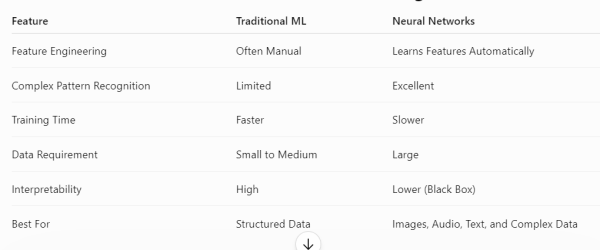
Neural Networks form the foundation of Deep Learning, enabling computers to solve complex tasks that traditional machine learning algorithms struggle with.
Understanding Neural Networks with a Simple Example
Imagine teaching a child to recognize a cat.
The child learns by observing features such as:
After seeing many examples, the child can identify a cat even if it has never seen that exact one before.
Neural Networks learn in a similar way by identifying patterns from large amounts of training data. The presentation illustrates this analogy using common cat features.
Why Do We Need Neural Networks?
Traditional Machine Learning algorithms work well for relatively simple prediction tasks, but Neural Networks excel at solving more complex problems involving images, audio, and language.
The presentation highlights applications such as:
- House Price Prediction
- Spam Detection
- Customer Churn Prediction
- Image Recognition
- Voice Recognition
- Language Translation
- ChatGPT
- Self-Driving Cars
These examples demonstrate the broad capabilities of Neural Networks across modern AI applications.
What is a Neuron?
A Neuron is the smallest building block of a Neural Network.
Each neuron receives information, processes it, and passes the result to the next layer of the network.
Components of a Neuron
Every neuron contains several important components.
1. Inputs (x)
Inputs are the features provided to the Neural Network.
Example:
- x₁ = Age
- x₂ = Salary
- x₃ = Experience
These input values help the model make predictions.
2. Weights (w)
Every input has a corresponding weight, representing its importance.
Example:
- Age → 0.2
- Salary → 0.8
- Experience → 0.5
Higher weights indicate that a feature has a greater influence on the prediction.
3. Bias (b)
The bias is an additional parameter added to the weighted inputs.
It helps the model shift the prediction and improves its ability to learn complex relationships from data.
4. Activation Function
After calculating the weighted sum of inputs and bias, the neuron applies an activation function.
An activation function decides whether the information should continue to the next neuron or not, introducing non-linearity into the model.
Popular Activation Functions
Activation functions allow Neural Networks to learn complex patterns beyond simple linear relationships.
1. Sigmoid Activation Function
The Sigmoid function converts values into a range between 0 and 1.
It is commonly used for binary classification problems.
2. Tanh Activation Function
The Tanh (Hyperbolic Tangent) function outputs values between -1 and 1.
It is useful when data contains both positive and negative values. The presentation includes an example related to movie reviews.
3. ReLU (Rectified Linear Unit)
ReLU is one of the most widely used activation functions in Deep Learning.
Its rule is simple:
- If the input is negative → Output = 0
- If the input is positive → Output remains unchanged
Formula:
f(x) = max(0, x)
Because of its simplicity and efficiency, ReLU is commonly used in hidden layers of deep neural networks.
4. Leaky ReLU
Leaky ReLU improves upon ReLU by allowing a small negative output instead of forcing all negative values to zero.
For example:
Input: -5
Output: -0.05
This helps reduce the “dying ReLU” problem.
5. Softmax
The Softmax function converts outputs into probabilities.
Example:
- Dog → 0.10
- Cat → 0.85
- Horse → 0.05
The class with the highest probability becomes the model’s prediction. Softmax is commonly used in multi-class classification problems.
Layers in a Neural Network
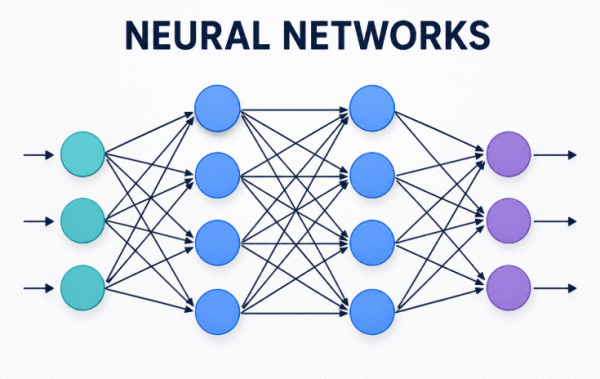
A Neural Network is organized into multiple layers that work together to process information.
The architecture diagram in the presentation shows:
- Input Layer – Receives the input features.
- Hidden Layer(s) – Extracts patterns and performs computations.
- Output Layer – Produces the final prediction.
This layered structure enables Neural Networks to learn increasingly complex representations of the data.
What is Forward Propagation?
Forward Propagation is the process of passing input data through the Neural Network—from the input layer, through the hidden layers, to the output layer—to generate a prediction.
In simple terms:
- Input data enters the network.
- Each neuron performs calculations.
- Activation functions process the outputs.
- The final prediction is generated.
What is a Loss Function?
A Loss Function measures how wrong the model’s prediction is.
It compares:
- Actual Value (Ground Truth)
- Predicted Value (Model Output)
and calculates the prediction error. Lower loss indicates better model performance.
What is Gradient Descent?
Gradient Descent is an optimization algorithm that helps the Neural Network reduce prediction errors by finding better values for the weights and bias.
The presentation explains this with a simple analogy:
- Loss Function → Like an exam score showing how poorly you performed.
- Gradient Descent → Like a study plan that helps improve your next score.
What is Backpropagation?
Backpropagation is the process of sending the prediction error backward through the Neural Network to update weights and bias so the model performs better in future predictions.
The presentation summarizes the relationship between Backpropagation and Gradient Descent with a memorable statement:
- Backpropagation tells the model what needs to change.
- Gradient Descent actually changes it.
Understanding Batch, Iteration, and Epoch
These three concepts are fundamental during Neural Network training.
Batch
A Batch is a subset of the training dataset processed at one time.
Example:
- Dataset → 1000 images
- Batch Size → 100 images
Iteration
An Iteration is completed when the model processes one batch and updates its weights once.
Epoch
An Epoch represents one complete pass through the entire training dataset.
Advantages of Neural Networks
According to the presentation, Neural Networks offer several benefits:
- Learn complex patterns automatically.
- Handle both structured and unstructured data.
- Achieve high accuracy with sufficient training data.
- Support transfer learning.
Disadvantages of Neural Networks
Despite their power, Neural Networks also have limitations.
The presentation lists the following disadvantages:
- Require large datasets.
- Computationally expensive.
- Longer training time.
- Harder to interpret (often called a “black box”).
- Can overfit if not properly regularized.
Real-World Applications of Neural Networks
Neural Networks are transforming industries worldwide. Common applications include:
- Image Recognition
- Face Detection
- Speech Recognition
- Language Translation
- Virtual Assistants
- Recommendation Systems
- Self-Driving Cars
- Medical Diagnosis
- Fraud Detection
- Cybersecurity Threat Detection
- Chatbots and Conversational AI
Best Practices for Using Neural Networks
To build effective Neural Network models:
- Collect high-quality training data.
- Normalize input features.
- Choose suitable activation functions.
- Monitor the loss during training.
- Prevent overfitting using regularization techniques.
- Experiment with different network architectures and learning rates.
Neural Networks vs Traditional Machine Learning