Artificial Intelligence has made remarkable progress in understanding images and videos. From unlocking smartphones with face recognition to enabling self-driving cars and medical image analysis, many of these breakthroughs are powered by Convolutional Neural Networks (CNNs).
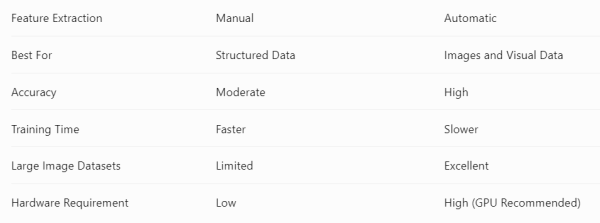
CNNs are a specialized type of Neural Network designed specifically for processing visual data. Unlike traditional machine learning algorithms that require manual feature extraction, CNNs automatically learn important patterns such as edges, textures, and shapes directly from images.
In this beginner-friendly guide, you’ll learn what Convolutional Neural Networks are, how they work, the different layers inside a CNN, popular CNN architectures, and their real-world applications. These concepts are covered in the AI learning material.
What is a Convolutional Neural Network (CNN)?
A Convolutional Neural Network (CNN) is a type of Artificial Neural Network specifically designed for working with images and visual data.
CNNs automatically learn meaningful features and patterns from images to perform tasks such as:
- Image Classification
- Object Detection
- Face Recognition
- Image Recognition
Unlike traditional machine learning methods, CNNs eliminate the need for manual feature engineering by learning directly from image data.
Why Do We Need CNNs?
Imagine you want to build a model that can identify whether an image contains:
With traditional machine learning, you would need to manually define important image features such as:
- Ear size
- Eye shape
- Tail length
- Fur texture
CNNs solve this problem by automatically learning these visual features during training, making them much more effective for image-based tasks.
How Does a CNN Work?
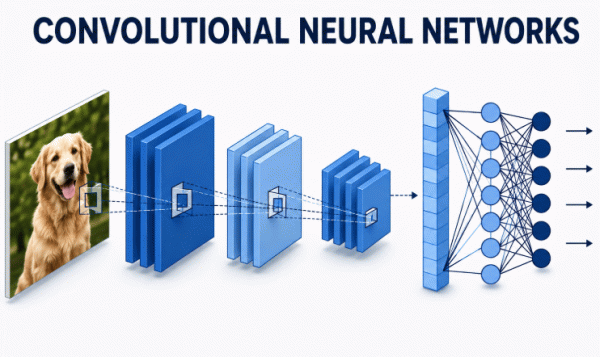
A CNN processes an image through several specialized layers. The architecture diagram in the presentation illustrates the complete workflow:
Input Image → Convolution Layer → Activation Function → Pooling Layer → Fully Connected Layer → Output Layer
Each layer performs a unique task that helps the model gradually understand the image.
1. Input Layer
The Input Layer receives the original image.
It performs no calculations. Instead, it simply passes the image to the next layer for processing.
2. Convolution Layer
The Convolution Layer is the most important part of a CNN.
Instead of analyzing the entire image at once, it scans small regions of the image using filters to detect meaningful patterns.
Purpose of the Convolution Layer
This layer extracts useful visual features such as:
- Edges
- Shapes
- Textures
- Patterns
- Objects
These extracted features help the network recognize increasingly complex structures in an image.
What is a Kernel?
A Kernel (also called a filter) is a small matrix that slides across the image.
As it moves, it detects specific visual features such as horizontal edges, vertical edges, corners, or textures.
3. Activation Function
After convolution, the extracted features pass through an Activation Function.
The presentation highlights ReLU (Rectified Linear Unit) as the most commonly used activation function in CNNs.
Why Activation Functions Are Important
Activation functions help CNNs:
- Train faster
- Perform simple computations
- Learn complex patterns
- Reduce the vanishing gradient problem
These benefits make deep neural networks more effective and easier to optimize.
4. Pooling Layer
The Pooling Layer reduces the size of the feature maps while preserving the most important information.
You can think of pooling as compressing an image without losing its essential characteristics.
Types of Pooling
The presentation introduces two common pooling techniques:
- Max Pooling
- Average Pooling
Why Pooling is Important
Pooling offers several advantages:
- Reduces computation
- Lowers memory usage
- Reduces overfitting
- Speeds up training
5. Fully Connected Layer (Dense Layer)
By this stage, the CNN has already extracted many useful features from the image.
Examples include:
- Eyes
- Nose
- Wheels
- Windows
- Fur
- Edges
- Shapes
These features are flattened into a one-dimensional vector and passed to the Fully Connected Layer, where they are combined to make the final prediction.
Unlike the convolution layer, every neuron in the Fully Connected Layer connects to every neuron in the next layer, allowing the network to use all extracted features together.
6. Output Layer
The Output Layer is the final stage of the CNN.
It produces the prediction, such as identifying whether an image contains a cat, dog, or horse.
Popular CNN Architectures
Over the years, researchers have developed several powerful CNN architectures.
1. LeNet
LeNet was one of the earliest successful CNN architectures.
It was developed for handwritten digit recognition and is commonly used in:
- Bank cheque processing
- Digit classification
2. AlexNet
AlexNet played a major role in popularizing deep learning for computer vision.
The presentation explains that AlexNet consists of:
- 5 Convolutional Layers
- 3 Fully Connected Layers
Its key innovations include:
- ReLU Activation
- Dropout
- GPU Training
3. VGG16
VGG16 is known for its simple yet effective architecture.
It contains:
- 13 Convolutional Layers
- 3 Fully Connected Layers
- Softmax Output Layer
The presentation highlights its simplicity and strong performance.
4. MobileNet
MobileNet is designed specifically for devices with limited computing power.
It is optimized for:
- Smartphones
- Edge Devices
- Embedded Systems
Its lightweight design enables fast and efficient image recognition.
Advantages of CNN
According to the presentation, CNNs provide several important advantages:
- Excellent image recognition performance
- Automatic feature extraction
- High accuracy
- Less manual feature engineering
- Works well on large image datasets
Disadvantages of CNN
Although CNNs are powerful, they also have some limitations.
The presentation lists the following disadvantages:
- Require large datasets
- Computationally expensive
- Need GPUs for efficient training
- Harder to interpret
- Long training time for large models
Real-World Applications of CNN
Convolutional Neural Networks are used across many industries.
Some common applications include:
- Face Recognition
- Image Classification
- Medical Image Analysis
- Self-Driving Cars
- Traffic Sign Recognition
- Object Detection
- Security Surveillance
- OCR (Optical Character Recognition)
- Satellite Image Analysis
- Defect Detection in Manufacturing
Best Practices for Using CNN
To build an effective CNN model:
- Use a large and diverse image dataset.
- Normalize image data before training.
- Apply data augmentation to improve generalization.
- Use GPU acceleration for faster training.
- Choose the appropriate CNN architecture for your application.
- Monitor model performance to prevent overfitting.
CNN vs Traditional Machine Learning