Artificial Intelligence has revolutionized how computers process not only images but also text, speech, and time-series data. Tasks such as language translation, speech recognition, sentiment analysis, and stock price prediction all involve sequential data, where the order of information is important.
Traditional Neural Networks process each input independently, making them unsuitable for sequence-based tasks. To solve this challenge, Recurrent Neural Networks (RNNs) were introduced. RNNs have a built-in memory that allows them to remember previous information while processing new inputs, making them ideal for understanding context over time.
In this beginner-friendly guide, you’ll learn what Recurrent Neural Networks are, how they work, their architecture, advantages, disadvantages, and real-world applications. These concepts are covered in the AI learning material.
What is a Recurrent Neural Network (RNN)?
A Recurrent Neural Network (RNN) is a type of Artificial Neural Network specifically designed for processing sequential data, where the order of the data matters.
Unlike Feedforward Neural Networks or Convolutional Neural Networks (CNNs), RNNs remember information from previous inputs while processing the current input. This memory enables the model to understand context and relationships across a sequence.
Why Do We Need RNNs?
Consider a sentence:
“The weather is very pleasant today.”
To understand the meaning of the word “today”, the model needs information from the previous words.
Traditional Neural Networks process every input independently.
Example:
- Dog → Prediction
- Cat → Prediction
- Bird → Prediction
Since each prediction is made independently, the model has no memory of previous inputs.
RNNs overcome this limitation by carrying information forward from one step to the next.
How Does an RNN Work?
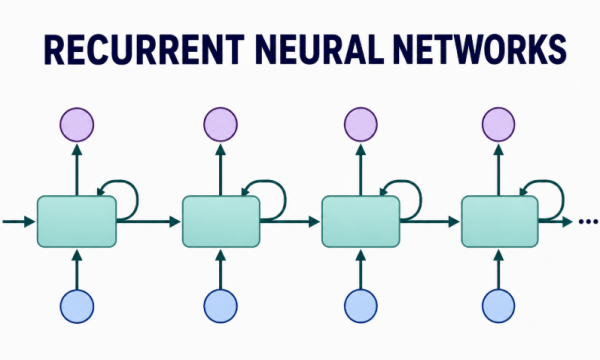
Unlike traditional neural networks, an RNN processes data one element at a time while maintaining a memory of previous inputs.
For example:
Word 1 → Word 2 → Word 3 → Word 4
At every step, the network carries forward its memory (hidden state), allowing it to understand relationships between elements in the sequence. The presentation illustrates this sequential flow using a simple memory diagram.
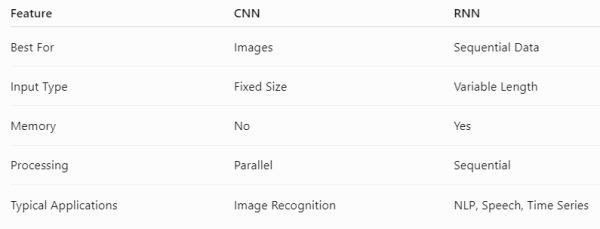
CNN vs RNN
The presentation includes a comparison table highlighting the major differences between CNNs and RNNs.
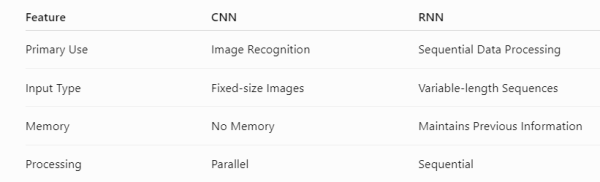
The comparison also explains that CNNs excel in computer vision tasks, while RNNs are better suited for natural language processing and time-series analysis.
Types of Data Suitable for RNN
RNNs are designed for sequence-based data.
According to the presentation, common examples include:
- Text
- Sentences
- Speech
- Audio
- Music
- Time-Series Data
- Stock Prices
- Weather Forecasting
- Sensor Data
Main Components of an RNN
The architecture diagram in the presentation shows the following flow:
Input Sequence → RNN Cell → Hidden State (Memory) → Output
Each component plays a specific role in processing sequential information.
Step 1: Input Sequence
The Input Sequence is the data fed into the RNN one element at a time.
For text processing, the sequence typically consists of words.
Example:
"I"
"Love"
"Machine"
"Learning"
The network processes each word in order rather than all at once.
Step 2: RNN Cell
The RNN Cell is the core component of the network.
Its responsibilities include:
- Receiving the current input.
- Receiving the previous hidden state (memory).
- Combining current and previous information.
- Producing a new hidden state.
- Generating the current output.
This repeated process allows the model to carry knowledge through the sequence.
Step 3: Hidden State (Memory)
The Hidden State is the most important concept in an RNN.
It acts as the network’s memory by storing information from previous inputs.
Every time a new element is processed, the hidden state is updated with new information while retaining useful knowledge from earlier steps.
Step 4: Output
The Output Layer produces the prediction based on:
- Current input
- Hidden state (memory)
Depending on the task, the output could be:
- Next word prediction
- Sentiment classification
- Stock price prediction
- Speech recognition result
The presentation identifies the output as the prediction generated by the RNN.
How Memory Helps in RNN
The hidden state allows the network to remember previous information.
For example:
Sentence:
"The movie was absolutely amazing."
When predicting the meaning of “amazing”, the model has already processed:
This context helps produce a more accurate understanding than processing words independently.
Advantages of Recurrent Neural Networks
According to the presentation, RNNs provide several important benefits:
- Naturally handle sequential data.
- Remember previous information.
- Process variable-length sequences.
- Effective for language and time-series tasks.
- Share parameters across time steps, reducing the number of learnable parameters.
Disadvantages of Recurrent Neural Networks
Although RNNs are powerful, they also have limitations.
The presentation lists the following disadvantages:
- Struggle with long-term dependencies.
- Suffer from the Vanishing Gradient Problem.
- Training is slower because inputs are processed sequentially.
- Cannot be fully parallelized like CNNs or Transformers.
Real-World Applications of RNN
Recurrent Neural Networks are widely used in applications involving sequential information.
Common applications include:
- Language Translation
- Text Generation
- Chatbots
- Speech Recognition
- Voice Assistants
- Sentiment Analysis
- Time-Series Forecasting
- Weather Prediction
- Stock Market Analysis
- Music Generation
- Handwriting Recognition
Best Practices for Using RNN
To achieve better performance with RNNs:
- Normalize sequential input data.
- Use sufficient training data.
- Apply regularization techniques to reduce overfitting.
- Monitor training for vanishing gradient issues.
- Consider advanced architectures such as LSTM or GRU for long sequences.
RNN vs CNN