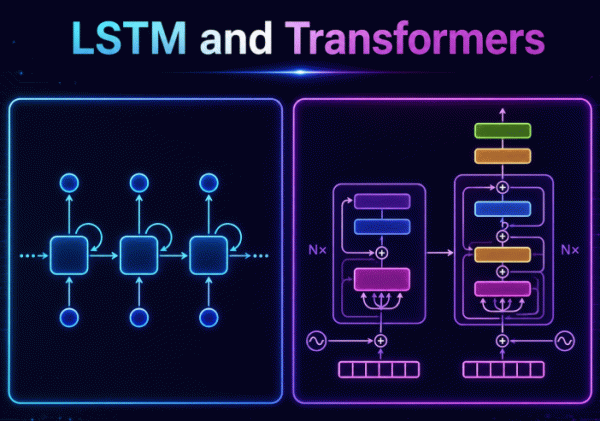
Artificial Intelligence has become increasingly capable of understanding text, speech, time-series data, and other sequential information. Two important technologies that played a major role in this evolution are Long Short-Term Memory (LSTM) networks and Transformers.
LSTM networks improved upon traditional Recurrent Neural Networks (RNNs) by giving models a better ability to remember important information over long sequences. Transformers later introduced Self-Attention, allowing models to process sequence elements in parallel and understand relationships between distant words more effectively.
In this beginner-friendly guide, we’ll explore LSTM, its memory and gates, Transformers, Self-Attention, Transformer components, advantages, disadvantages, and the difference between these approaches. The concepts are based on the learning material.
What is LSTM?
Long Short-Term Memory (LSTM) is a specialized type of Recurrent Neural Network (RNN) designed to remember important information for longer periods while forgetting information that is no longer useful.
An LSTM can use information from the past to make better predictions when working with sequential data.
This makes LSTMs particularly useful when the relationship between two pieces of information occurs far apart in a sequence.
Why is LSTM Needed?
Traditional RNNs can struggle to remember information from much earlier in a long sequence.
Consider this example:
“I grew up in France… I can speak fluent French.”
When the model reaches “French”, it needs to remember the earlier information about France.
A normal RNN can struggle to retain this information when the sentence becomes long, whereas an LSTM is designed to preserve important information for longer periods.
What Does “Long Short-Term Memory” Mean?
The name LSTM describes its ability to handle different types of information.
Long-Term Memory
LSTM can remember important information from many previous time steps.
For example:
Monday → Tuesday → Wednesday → Thursday → Friday
An LSTM can retain useful information from Monday even when processing Friday.
Short-Term Memory
LSTM also considers recent information.
For example, when predicting tomorrow’s stock price, information such as:
- Yesterday’s stock price
- Today’s stock price
- Recent trends
can be important.
Memory
An LSTM contains a special memory cell that stores useful information.
Unlike a standard RNN, this memory is designed to survive for a much longer period.
Components of LSTM
An LSTM primarily uses several components called gates along with a Cell State.
The main components covered in the learning material are:
- Forget Gate
- Input Gate
- Cell State
- Output Gate
Let’s understand each one.
1. Forget Gate
The Forget Gate decides which old information should be removed from the memory.
It uses:
- Current input xt
- Previous hidden state ht−1
to determine what information should be forgotten.
Simple Example
Consider:
“I was born in France… I speak French.”
The LSTM can retain the information about France because it may be important for understanding the later part of the sentence.
2. Input Gate
The Input Gate decides what new information should be stored in the memory.
In simple terms:
Forget Gate → What should I remove?
Input Gate → What new information should I remember?
This selective memory mechanism is one of the key differences between LSTM and a standard RNN.
3. Cell State
The Cell State is the core memory of an LSTM.
A simple way to understand it is:
New Memory =
Keep Useful Old Memory
+
Add Useful New Memory
This mechanism allows LSTMs to retain important information across long sequences.
4. Output Gate
The Output Gate determines which part of the stored memory should become the output.
This allows the LSTM to selectively expose the information needed for the current prediction.
Advantages of LSTM
LSTMs provide several important benefits:
- Remember long-term dependencies in sequential data.
- Reduce the vanishing gradient problem compared with standard RNNs.
- Learn patterns from both short and long sequences.
- Work well for time-series forecasting.
- Perform effectively in Natural Language Processing (NLP).
Disadvantages of LSTM
LSTMs also have some limitations:
- More complex than standard RNNs.
- Require more computational power.
- Take longer to train because processing is sequential.
- Contain many parameters, increasing memory requirements.
- Can overfit when trained on small datasets.
What are Transformers?
A Transformer is a Deep Learning architecture designed to process sequential data using a mechanism called Self-Attention.
Unlike RNNs and LSTMs, Transformers can process sequence elements in parallel, making them significantly faster and more effective for many sequence modeling tasks.
Transformers are also the foundation of many modern AI systems, including large language models such as ChatGPT, Gemini, and Claude, according to the learning material.
What is Self-Attention?
Self-Attention is the core mechanism that allows a Transformer to determine which words in a sentence are most relevant to one another.
Instead of processing words strictly one after another, a Transformer can examine relationships between different words in the sequence.
Example
Consider:
“The animal didn’t cross the street because it was too tired.”
The Transformer can use Self-Attention to understand that “it” refers to “the animal”, even though several words appear between them.
This ability to capture relationships between distant words is one of the major strengths of Transformers.
Why Were Transformers Introduced?
Before Transformers, sequence modeling relied heavily on RNNs and LSTMs.
However, these approaches had several limitations:
- They processed data sequentially.
- Training was slower because computations could not be fully parallelized.
- Very long sequences remained challenging.
- Long-distance relationships between words were harder to learn.
Transformers addressed many of these limitations by introducing Self-Attention and parallel processing.
Components of a Transformer
The architecture diagram in the presentation shows the following pipeline:
Input Sentence → Word Embeddings → Positional Encoding → Multi-Head Self-Attention → Feed Forward Network → Encoder Output → Decoder → Final Output.
Let’s understand these components.
Step 1: Input Sentence
The Transformer first receives the input sentence.
Computers cannot directly understand words as humans do, so the sentence needs to be converted into numerical representations.
Step 2: Word Embeddings
The Transformer converts every word into a vector, which is essentially a list of numbers representing the word.
These numerical representations allow the neural network to process the input mathematically.
Step 3: Positional Encoding
Transformers process sequence elements in parallel.
Because of this, they do not naturally know the order of the words.
Positional Encoding provides information about where each word appears in the sequence.
For example:
I → Position 1
love → Position 2
AI → Position 3
This allows the Transformer to consider both the words and their positions.
Step 4: Multi-Head Self-Attention
Multi-Head Self-Attention is the heart of the Transformer architecture.
It allows every word to look at other words and understand the context of the sentence.
Why is it Called “Multi-Head”?
Instead of using only one attention mechanism, Transformers use multiple attention heads.
Each head can learn different relationships.
For example:
Head 1 → Grammar
Head 2 → Meaning
Head 3 → Context
Head 4 → Relationships
The learning material uses these examples to explain why multiple attention heads are useful.
Step 5: Feed Forward Network
After Self-Attention, each word is processed independently by a small neural network called the Feed Forward Network (FFN).
The FFN helps further process the contextual information produced by the attention mechanism.
Step 6: Encoder Output
After passing through the encoder layers, the Transformer generates a contextual representation of the entire sentence.
For example, with:
“I love AI”
the model develops contextual representations where:
- I understands its meaning.
- love understands the relationship between the subject and object.
- AI understands that it is the object being loved.
Step 7: Decoder
The Decoder generates the output one token at a time.
Its main purpose is to generate the output based on what the Encoder has understood.
Step 8: Final Output
The final stage produces the model’s prediction or generated output.
Depending on the application, this could be:
- A translated sentence
- A generated response
- A predicted sequence
- A classification result
LSTM vs Transformer
Understanding the difference between LSTM and Transformer is important when learning modern AI.
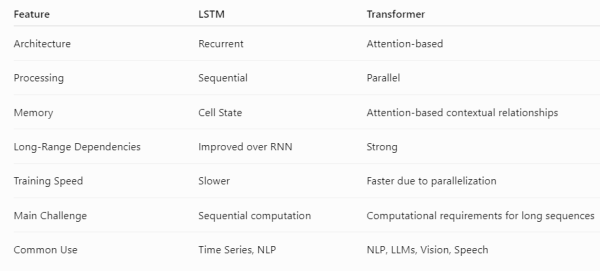
The learning material specifically highlights the sequential nature of LSTMs and the parallel processing capabilities of Transformers.
Advantages of Transformers
According to the provided material, Transformers offer several major advantages:
- Process all tokens in parallel, making training faster than RNNs and LSTMs.
- Capture long-range dependencies effectively.
- Scale well to very large datasets and models.
- Achieve state-of-the-art performance on many NLP tasks.
- Can be adapted for vision, speech, and multimodal applications.
Disadvantages of Transformers
Transformers also come with significant computational requirements.
The material highlights that they:
- Require large amounts of training data for the best performance.
- Can require significant computational resources for training and inference.
- Have attention computation that grows quadratically with sequence length in the original Transformer architecture.
- Can be expensive to train and deploy when models are very large.
Real-World Applications
LSTM and Transformer architectures can be applied to many sequence-related problems.
LSTM Applications
- Time-Series Forecasting
- Stock Price Analysis
- Natural Language Processing
- Speech Processing
- Sequential Pattern Recognition
Transformer Applications
- Large Language Models
- Machine Translation
- Text Generation
- Natural Language Processing
- Computer Vision
- Speech Processing
- Multimodal AI
Best Practices for Beginners
When learning sequence models, it helps to understand them in this order:
- Learn the basics of RNNs.
- Understand why standard RNNs struggle with long-term dependencies.
- Learn how LSTM gates solve some of these problems.
- Understand the concept of Self-Attention.
- Learn how Transformers process tokens in parallel.
- Understand Word Embeddings and Positional Encoding.
- Explore Encoder and Decoder architectures.
- Move toward modern Transformer-based models.