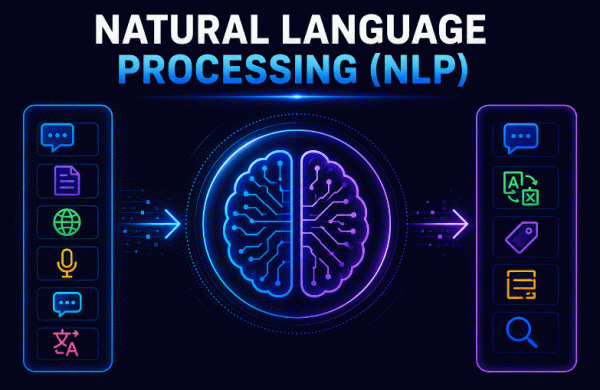
Artificial Intelligence is becoming increasingly capable of communicating with humans. From ChatGPT answering questions to Google Translate converting languages and voice assistants responding to commands, AI systems are constantly working with human language.
But how does a computer understand something as complex as language?
The answer is Natural Language Processing (NLP).
NLP is a branch of Artificial Intelligence that helps computers understand, interpret, generate, and interact with human language. This guide covers the fundamentals of NLP, including text preprocessing, tokenization, stop word removal, stemming, lemmatization, and important feature extraction techniques such as Bag of Words, TF-IDF, and Word Embeddings. These topics are covered in the NLP learning material.
What is Natural Language Processing (NLP)?
Natural Language Processing (NLP) is a field of Artificial Intelligence that enables computers to work with human language.
NLP allows machines to:
- Understand text
- Interpret language
- Generate language
- Interact with humans
Some everyday examples of NLP include:
- ChatGPT understanding user questions
- Google Translate translating languages
- Siri and Alexa understanding voice commands
- Spam email detection
- Sentiment analysis of reviews
In simple terms:
NLP helps computers understand human language.
Why Do We Need NLP?
Humans communicate naturally using language.
Consider the sentence:
“Book me a flight to New York tomorrow.”
A human can easily understand the important information:
- Action: Book
- Object: Flight
- Destination: New York
- Time: Tomorrow
However, a computer initially sees the sentence as a sequence of individual characters:
B o o k m e a f l i g h t
NLP helps transform this unstructured language into meaningful information that a machine learning model can process.
NLP Pipeline
An NLP system generally processes language through multiple stages.
The pipeline shown in the learning material is:
Raw Text
↓
Text Cleaning
↓
Tokenization
↓
Feature Extraction
↓
Machine Learning / Deep Learning Model
↓
Prediction
↓
Output
Each stage prepares the text for the next step.
Text Preprocessing in NLP
Before text can be provided to a machine learning model, it needs to be cleaned and prepared.
This process is known as Text Preprocessing.
Text preprocessing can include:
- Text Cleaning
- Lowercasing
- Tokenization
- Stop Word Removal
- Stemming
- Lemmatization
Let’s understand each one.
1. Text Cleaning
Text Cleaning involves removing unnecessary information from raw text.
For example:
Original
Hello!!! This is AMAZING
After Cleaning
hello this is amazing
The learning material demonstrates this transformation as an example of preparing text for NLP processing.
Common cleaning operations include:
- Removing special characters
- Removing HTML tags
- Converting text to lowercase
- Removing extra spaces
The exact cleaning steps depend on the NLP task and the type of data being processed.
2. Lowercasing
Lowercasing converts all text into lowercase.
For example:
Before:
Machine Learning
After:
machine learning
Why is this useful?
Without normalization, a system may treat:
Machine
machine
MACHINE
as different text forms.
Lowercasing can reduce this unnecessary variation.
3. Tokenization
Tokenization means breaking text into smaller units called tokens.
Tokens can be words, sentences, or other units depending on the tokenizer.
There are two examples covered in the material.
Word Tokenization
Consider:
I love Artificial Intelligence
The sentence can be divided into individual word tokens:
“I”
“love”
“Artificial”
“Intelligence”
Word tokenization is useful when a model needs to analyze language at the word level.
Sentence Tokenization
A paragraph can also be divided into individual sentences.
Example:
I love AI. NLP is amazing.
becomes:
Sentence 1: I love AI.
Sentence 2: NLP is amazing.
4. Stop Word Removal
Stop Word Removal involves removing common words that may provide less useful information for a particular NLP task.
Examples include:
For example:
Before
This is a very good movie
After
very good movie
However, stop word removal should not automatically be applied to every NLP problem. Whether a word is useful depends on the task and the model.
5. Stemming
Stemming reduces words to a common root form.
For example:
playing
played
plays
can be reduced to:
play
Stemming is generally a simpler normalization technique and may produce root forms that are not always complete dictionary words.
6. Lemmatization
Lemmatization is similar to stemming but uses a more informed approach to reduce words to their base dictionary form, known as a lemma.
Examples from the learning material include:
running → run
better → good
The key difference is that lemmatization aims to produce a meaningful base word rather than simply cutting parts of a word.
Stemming vs Lemmatization
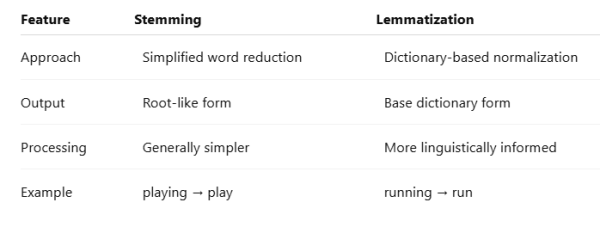
Both techniques can reduce unnecessary variations in words, but they approach the problem differently.
Feature Extraction in NLP
After preprocessing, text needs to be represented in a numerical form that a machine learning model can understand.
This is where Feature Extraction becomes important.
The learning material introduces three important approaches:
- Bag of Words
- TF-IDF
- Word Embeddings
1. Bag of Words (BoW)
Bag of Words (BoW) represents documents using word occurrence information.
Consider two documents:
Doc1: I love AI
Doc2: I love Python
The vocabulary becomes:
I
love
AI
Python
The documents can then be represented numerically:
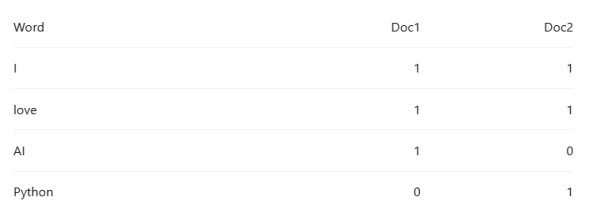
The model can therefore work with numerical representations instead of raw text.
Limitation of Bag of Words
BoW focuses mainly on word occurrence and does not capture the deeper meaning or relationships between words.
This is one reason more advanced representations such as TF-IDF and Word Embeddings are useful.
2. TF-IDF
TF-IDF stands for:
Term Frequency – Inverse Document Frequency
It is used to give different importance to words depending on how frequently and how uniquely they occur in documents.
The material highlights examples such as:
- cryptography
- neural network
as relatively rare and meaningful terms that can receive higher importance, while common words such as:
receive lower importance.
In simple terms:
TF-IDF helps identify words that are important within a document compared with a collection of documents.
3. Word Embeddings
Modern NLP systems often represent words as vectors.
This approach is called Word Embeddings.
Instead of representing a word simply as 0 or 1, a word can be represented using a vector containing numerical values.
For example:
King → [0.25, 0.87, 0.11]
One major benefit of word embeddings is that words with related meanings can have similar positions in vector space.
The material gives the example of:
being closer together in vector space.
This makes embeddings much more useful for capturing semantic relationships than simple word-count representations.
NLP Preprocessing vs Feature Extraction
These two concepts are related but different.
Text Preprocessing
Preprocessing prepares and normalizes the raw text.
Examples:
- Cleaning
- Lowercasing
- Tokenization
- Stop word removal
- Stemming
- Lemmatization
Feature Extraction
Feature extraction converts prepared text into numerical representations.
Examples:
- Bag of Words
- TF-IDF
- Word Embeddings
A simple workflow is:
Raw Text
↓
Preprocessing
↓
Clean Text
↓
Feature Extraction
↓
Numerical Representation
↓
ML / Deep Learning Model
Real-World Applications of NLP
NLP is already used in many everyday applications.
Examples include:
Chatbots
AI assistants can understand user questions and generate responses.
Machine Translation
Systems such as translation applications can convert text from one language into another.
Voice Assistants
Voice assistants can process spoken commands and interpret their meaning.
Spam Detection
NLP techniques can help identify unwanted or suspicious email messages.
Sentiment Analysis
Businesses can analyze reviews and feedback to determine whether the sentiment is positive, negative, or otherwise categorized.
These examples are directly highlighted in the learning material.
Why NLP is Important for Modern AI
Human language contains enormous amounts of information.
Emails, documents, social media posts, customer reviews, messages, search queries, and conversations all contain valuable data.
NLP provides a way to transform this unstructured language into information that machine learning systems can process.
The basic idea is:
Human Language
↓
NLP
↓
Structured Representation
↓
Machine Learning / Deep Learning
↓
Prediction or Generation
This foundation is essential for building systems that work with language.