Artificial Intelligence is evolving rapidly, and developers no longer need to build every AI model completely from scratch. Today, researchers and developers can access thousands of pre-trained models, datasets, tools, and AI applications through platforms designed specifically for the AI community.
One of the most popular platforms in this space is Hugging Face.
Hugging Face provides open-source tools, libraries, pre-trained models, datasets, and deployment options for Natural Language Processing (NLP), Machine Learning, and Artificial Intelligence. It is particularly well known for its Transformers library, which provides access to models such as BERT, GPT, and T5.
This beginner-friendly guide explains what Hugging Face is, why it was created, how the Model Hub works, what datasets and Spaces are, and how its newer storage feature, Buckets, fits into the AI ecosystem.
What is Hugging Face?
Hugging Face is a platform focused on Artificial Intelligence and Machine Learning.
It provides:
- Open-source AI tools
- Pre-trained models
- Libraries
- Datasets
- Training tools
- Deployment options
The platform is particularly popular in the NLP and Transformer ecosystem.
A simple way to understand Hugging Face is:
Hugging Face is like GitHub for AI models.
GitHub allows developers to upload, share, and collaborate on code. Similarly, Hugging Face allows AI researchers and engineers to upload and share trained AI models.
Why Was Hugging Face Created?
Before platforms such as Hugging Face became popular, using advanced AI models could be difficult.
Training AI models often required:
- Huge computing resources
- Significant development effort
- Specialized knowledge
- Separate implementations
The learning material explains that researchers could create powerful models, but others could not always use them easily. Companies also had their own implementations.
Hugging Face helped address these challenges by providing a shared ecosystem containing:
- Pre-trained models
- Easy model sharing
- Standard APIs
- Datasets
- Training tools
- Deployment options
Why Are Pre-Trained Models Important?
Training a large AI model from scratch can require significant amounts of data, computing power, and time.
A pre-trained model has already learned patterns from training data and can be reused or adapted for other applications.
For example, instead of building an NLP model from zero, a developer can start with an existing model and use it for a particular task.
This makes AI development much more accessible.
Hugging Face Model Hub
The Model Hub is one of the most important parts of Hugging Face.
According to the learning material, the Model Hub contains thousands of pre-trained models.
These models cover different areas of Artificial Intelligence, including:
- NLP
- Computer Vision
- Audio
- Generative AI
- Large Language Models
The Model Hub allows developers and researchers to discover and reuse models rather than starting every project from scratch.
NLP Models on Hugging Face
Hugging Face provides access to many popular text and language models.
The learning material highlights:
BERT
BERT is presented as a model for text understanding.
It can be used as a foundation for various language-related tasks.
GPT
GPT is associated with text generation.
It is designed to generate text based on the input context.
T5
T5 is described as a model for text-to-text tasks.
This makes it suitable for tasks where both input and output can be represented as text.
RoBERTa
RoBERTa is highlighted for classification tasks.
Llama
Llama is presented as a Large Language Model (LLM).
Mistral
Mistral is included as an example of a model used in Generative AI.
Computer Vision Models
Hugging Face is not limited to text-based AI.
The platform also provides Computer Vision models.
The material highlights several examples:
ResNet
Used for:
Image Classification
YOLO
Used for:
Object Detection
Stable Diffusion
Used for:
Image Generation
ViT
Used for:
Vision Transformer-based applications
This demonstrates how the Hugging Face ecosystem extends beyond NLP into modern Computer Vision.
Audio Models
Hugging Face also supports models designed to process audio and speech.
Two examples from the learning material are:
Whisper
Used for:
Speech-to-Text
Wav2Vec
Used for:
Speech Recognition
These models allow developers to build applications that work with spoken language and audio data.
What Are Datasets?
AI models need data to learn.
A dataset is a collection of data used for training AI models. The learning material emphasizes this with a simple concept:
Without datasets, there is no training. Without training, there is no AI.
Datasets can contain different types of information, such as:
- Text
- Images
- Audio
- Video
- Structured data
Choosing an appropriate dataset is an important part of building an AI system.
Popular Datasets
The material highlights several well-known datasets and data sources:
- Common Crawl
- Wikipedia
- ImageNet
- COCO
- LAION
- OpenWebText
These datasets represent different types of information and are associated with different AI use cases.
What Are Hugging Face Spaces?
Spaces are hosted AI applications or demos that run in a web browser.
This is one of the most useful features for developers who want to demonstrate an AI project without requiring users to install the application locally.
A Space can provide an interactive interface where users can try an AI model or application directly.
Why Do Developers Love Spaces?
The learning material highlights several uses of Spaces:
- Showcase projects
- Build AI demos
- Share research
- Host portfolios
- Test models
- Deploy AI applications quickly
For students and developers, this makes Spaces particularly useful for creating publicly accessible AI project demonstrations.
For example, instead of simply showing screenshots of an AI project in a portfolio, you can create an interactive demo that people can actually use.
What Are Hugging Face Buckets?
Buckets are described in the material as a relatively new feature of Hugging Face.
They provide cloud storage for AI assets.
The learning material compares them conceptually with:
- Google Drive
- Dropbox
- AWS S3
but describes Buckets as being optimized for AI workloads.
This provides another part of the Hugging Face ecosystem for working with AI-related files and assets.
Hugging Face Ecosystem at a Glance
A simple way to understand the major components covered in the material is:
Hugging Face
|
---------------------------------
| | |
Model Hub Datasets Spaces
| | |
Models Training AI Demos
|
| | |
NLP CV Audio
|
BERT, GPT, T5,
Llama, Mistral
The platform therefore brings together models, data, applications, and AI-related assets in one ecosystem.
Why Hugging Face is Useful for AI Developers
Hugging Face makes it easier to experiment with modern AI technologies.
Instead of spending all your time building infrastructure, you can focus on:
- Understanding AI models
- Experimenting with pre-trained models
- Building applications
- Testing different datasets
- Creating AI demos
- Sharing projects
This is particularly valuable for beginners who want practical experience with modern AI.
Hugging Face for Students
Hugging Face can be especially useful for students learning:
- Machine Learning
- Deep Learning
- NLP
- Computer Vision
- Generative AI
- Large Language Models
A beginner can start by exploring existing models, understanding how they work, and then gradually build their own AI applications.
Spaces can also be useful for creating portfolio projects that demonstrate practical skills.
Hugging Face vs Building an AI Model from Scratch
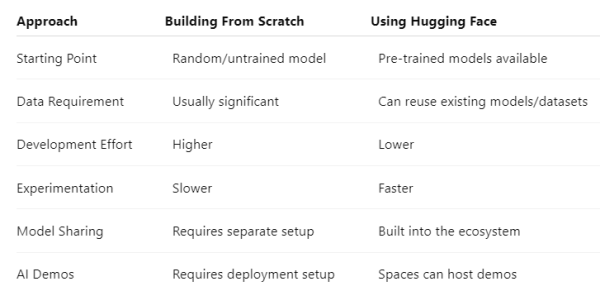
The major advantage is not that Hugging Face eliminates the need for AI knowledge, but that it provides reusable components that make experimentation and development easier.
A Simple Hugging Face Learning Roadmap
If you’re completely new to Hugging Face, a practical learning path is:
Python
↓
Machine Learning Basics
↓
Deep Learning Basics
↓
NLP / Computer Vision Basics
↓
Explore Hugging Face Model Hub
↓
Understand Pre-Trained Models
↓
Work with Datasets
↓
Build a Simple AI Application
↓
Create a Hugging Face Space
↓
Build and Share AI Projects
This progression helps you understand not only the platform but also the AI concepts behind the models.