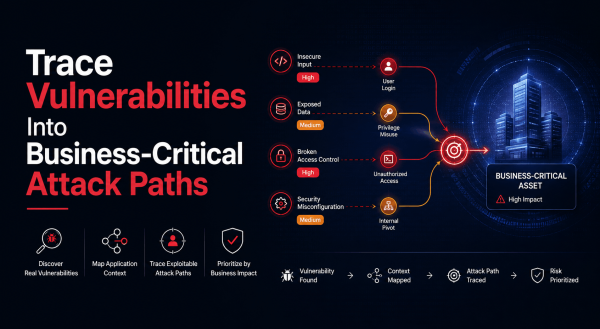
A vulnerability report can tell you that something is wrong. It does not always tell you what an attacker can actually do with it.
This distinction matters in modern applications. A single weakness may have limited impact when viewed alone, but several weaknesses can combine into a path that reaches sensitive data, privileged functions, or a critical business process.
For security teams, the challenge is therefore shifting from finding more vulnerabilities to understanding which vulnerabilities can be connected into meaningful attack paths.
What Makes an Attack Path Business-Critical?
A business-critical attack path is a sequence of exploitable weaknesses that allows an attacker to move from an initial entry point toward an asset or function that matters to the organization.
The important part is the connection between the vulnerabilities.
For example, an attacker might start with a low-privileged account, exploit an authorization weakness, access another user’s object, and then reach a privileged workflow. None of these steps necessarily represents the entire risk on its own.
The combined path tells a different story.
A useful way to understand business-critical attack paths is to look beyond individual vulnerability severity and trace how an attacker could move through the application.
The Anatomy of an Attack Path
Most business-critical attack paths contain several components.
1. Initial Access
The path starts with an entry point available to the attacker. This could be a public endpoint, compromised account, exposed API, or weakness in authentication.
2. Exploitable Weakness
The attacker then takes advantage of a vulnerability or security control failure. Common examples include broken access control, weak authorization, injection flaws, or insecure object references.
3. Movement
The attacker uses the result of the first step to reach another part of the application.
This is where context becomes important. A vulnerability may only become useful after the attacker has obtained a particular role, session, identifier, or piece of information.
4. Business-Critical Target
The final stage involves something valuable to the organization.
This might include:
- Customer records
- Financial information
- Administrative functionality
- Payment operations
- Sensitive internal data
- High-privilege accounts
The complete sequence provides much more useful information than a list of unrelated findings.
Why Vulnerability Severity Is Not Enough
Security teams often use CVSS and similar scoring systems to prioritize remediation. These scores are useful, but they do not always represent the actual business consequences of exploitation.
Consider two vulnerabilities.
One has a high technical severity but affects an isolated public page. Another has a moderate severity but exists inside an administrative workflow and can be chained with an authorization weakness.
The second issue may represent the greater business risk.
This is why attack-path analysis should consider more than technical severity. Exploitability, attacker access, application context, affected assets, and business function all matter.
How Security Teams Can Trace Attack Paths
Tracing attack paths requires connecting findings instead of reviewing them independently.
A practical approach is to ask a series of questions:
- Where can an attacker enter?
- What permissions do they initially have?
- Which vulnerabilities can they exploit from that position?
- What additional access does each successful step provide?
- Which systems, records, or workflows become reachable?
- Does the final target have meaningful business value?
This creates a chain from initial exposure to potential business impact.
Authenticated testing is particularly important because many serious weaknesses only become visible after login. Authorization controls, user roles, object ownership, and privileged workflows need to be evaluated as part of the same journey.
Connecting Findings Across Application Behavior
Modern applications are rarely simple collections of independent pages.
A single business process can involve a browser interface, several API calls, session state, database objects, and multiple permission checks.
An attacker can move between these components while maintaining the same session.
For this reason, security testing needs to understand relationships between application functions. A broken authorization check on one endpoint may become significantly more dangerous when another endpoint exposes the identifiers or privileges needed to exploit it.
The relationship between vulnerabilities is often where the real risk becomes visible.
Prioritizing Paths by Business Impact
Once attack paths have been identified, security teams still need to determine which ones deserve immediate attention.
A useful prioritization model can consider:
- Reachability: How easily can the attacker begin the attack?
- Privileges: What level of access is required?
- Exploitability: Can the weakness be reliably abused?
- Asset sensitivity: What information or functionality is exposed?
- Business importance: Which business process could be affected?
- Attack path outcome: What does the attacker ultimately gain?
This approach helps security teams move away from simply asking which vulnerability has the highest score.
Instead, they can ask a more useful question:
Which exploitable path could cause the greatest business impact?
Making Attack-Path Analysis Actionable
Attack-path findings are most useful when they provide enough evidence for security teams to reproduce and understand the sequence.
A useful finding should explain:
- Where the path begins
- Which vulnerabilities are involved
- How the attacker moves between steps
- What privileges are gained
- Which asset or function is ultimately exposed
- Why the path matters
This gives developers and security engineers a clear remediation target instead of another item in a large vulnerability queue.
Final Thoughts
The number of vulnerabilities discovered during a security assessment is not the same as the amount of risk an organization faces.
A better picture emerges when individual weaknesses are connected into realistic attack paths.
For security teams, this means looking beyond isolated findings and examining how attackers can move through authentication, authorization, APIs, business logic, and sensitive workflows.
Business-critical attack-path analysis turns vulnerability data into a clearer picture of what could actually happen during an attack.
That shift can help organizations focus limited remediation resources on the vulnerabilities and chains that have the greatest potential impact on the business.