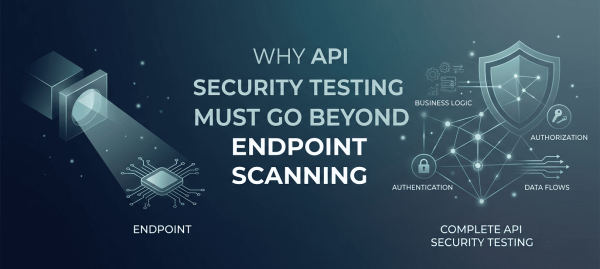
A secure-looking API endpoint can still hide serious security gaps. 95% of successful API attacks now occur within authenticated sessions, showing why checking exposed endpoints alone is not enough.
Endpoint scanning can identify exposed APIs and common vulnerabilities, but modern attacks often target what happens after authentication. Attackers look for broken authorization, excessive data exposure, weak business logic, and ways to abuse legitimate API workflows.
That is where API security testing needs to go deeper. A proper approach should test how APIs behave across users, roles, objects, requests, and connected workflows. It should also validate whether security controls actually stop realistic attack paths.
If you are relying only on endpoint scanning, you may be checking whether your APIs are visible while missing how they can be abused.
Why API Endpoint Scanning Alone Falls Short
Endpoint scanning is useful, but it only tells you what API endpoints exist and whether they expose obvious vulnerabilities. It does not prove that the API is enforcing security correctly across different users, roles, objects, and workflows.
The bigger issue is what happens inside those endpoints. OWASP lists risks such as Broken Object Level Authorization (BOLA), Broken Function Level Authorization (BFLA), Broken Object Property Level Authorization, and unrestricted access to sensitive business flows among its API Security Top 10.
Key reasons endpoint scanning falls short:
- Misses Logic Flaws: Scanners cannot detect when an authenticated user accesses another user’s private data through valid parameters.
- Ignores Context: Tools evaluate endpoints in isolation rather than testing full multi-step workflows.
- Creates False Confidence: Passing an automated scan does not mean your application logic is secure.
An endpoint can look secure during a basic vulnerability scan while its authorization logic still allows unauthorized access. That is the gap attackers can exploit.
Endpoint Scanning vs Complete API Security Testing
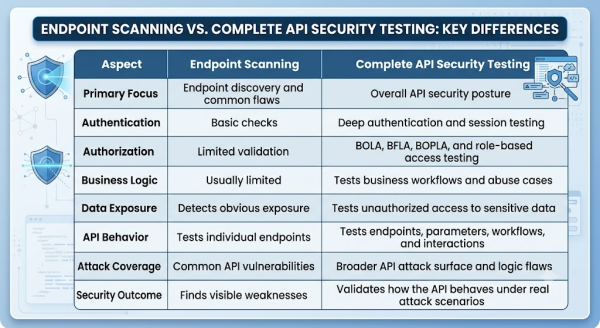
Endpoint scanning checks surface-level API routes for known vulnerabilities, while complete API security testing analyzes underlying business logic, authorization flaws, and complex multi-step workflows. Understanding this distinction helps teams move beyond basic surface checks to achieve true API resilience.
Here is a simplified table to help you understand the difference clearly:
Key Vulnerabilities API Endpoint Scanning Misses
API endpoint scanning can identify exposed endpoints and common technical flaws, but it may miss deeper API security risks. These include authorization weaknesses, business logic vulnerabilities, sensitive data exposure, and unsafe handling of user-controlled properties.
Broken Object Authorization
Broken Object Level Authorization (BOLA) occurs when an API fails to verify whether a user can access a specific object. Endpoint scanning may find the endpoint but miss authorization flaws that let attackers access another user’s records by changing object identifiers.
Broken Function Authorization
Broken Function Level Authorization (BFLA) happens when users can access functions or API operations outside their assigned permissions. An endpoint may appear secure during scanning while weak role-based access controls allow a standard user to call administrative functions.
Business Logic Flaws
Business logic flaws occur when attackers misuse legitimate API workflows in ways developers did not anticipate. Endpoint scanning may validate individual requests but miss abuse cases involving payment flows, account actions, transaction limits, or multi-step API interactions.
Sensitive Data Exposure
Sensitive data exposure occurs when APIs return information that users should not receive. Basic endpoint scanning may detect exposed responses but often cannot determine whether specific users, roles, or application workflows are authorized to access the returned data.
Mass Assignment Vulnerabilities
Mass assignment vulnerabilities occur when APIs automatically bind user-supplied parameters to internal application objects. Attackers may modify properties such as roles, permissions, account status, or ownership by adding unexpected fields to otherwise legitimate API requests.
How Attackers Exploit APIs Beyond the Endpoint
Attackers don’t stop at one endpoint. They map the API, then look for the weak spot between requests. According to Wallarm’s 2026 API ThreatStats Report, 56% of API vulnerabilities can be exploited by low-skill actors.
Most abuse starts with a valid login. The attacker signs in normally, then swaps object IDs in requests. AppSecure notes that in Meta’s disclosed IDOR cases, authentication worked but server-side authorization failed at the object level.
Next comes chaining. Attackers link harmless calls into one workflow, such as skipping a payment step or replaying a request. Each call looks legitimate. The flaw only appears across the sequence, which scanners rarely test.
Then there is scale. The same report found 67% of API vulnerabilities are rated high or critical, and 40% are tied to organized cybercrime. These are repeatable attack chains, not rare exploits. Testing must keep up.
What a Complete API Security Testing Approach Should Cover
A complete API security testing approach evaluates entire business workflows, role permissions, and backend data flows. It goes beyond surface scanning to ensure total application resilience against complex attacks.
- Contextual BOLA and BFLA Validation: Tests object and function level access control policies across different user roles to prevent unauthorized data access.
- Business Logic Workflow Testing: Inspects multi-step API transactions to ensure threat actors cannot manipulate workflow steps or skip validation checks.
- Mass Assignment Protection Checks: Validates API parameters during object creation to block unauthorized modifications to backend properties and user roles.
- Data Over-exposure Analysis: Scans API response payloads for sensitive data fields, private records, and unnecessary user information exposed to frontends.
- Authentication and Token Handling: Verifies JWT implementations, OAuth flows, token expiration times, and session invalidation mechanisms across every API endpoint.
- Rate Limiting and Abuse Controls: Tests API endpoints against automated brute-force attempts, credential stuffing, and resource exhaustion attacks under high load.
- Third-Party Dependency Scanning: Analyzes external libraries, open-source modules, and integrated webhooks for known vulnerabilities and unpatched CVEs.
- Continuous Exploit Validation: Integrates automated security tests into CI/CD pipelines to validate vulnerabilities immediately after every new code release.
- Security Misconfiguration Audit: Checks server headers, CORS policies, TLS configurations, and unhandled error messages for accidental information disclosure.
Wrapping Up
Endpoint scanning is useful for discovering APIs and finding common technical weaknesses. But it cannot confirm whether authentication, authorization, business logic, and data access controls work correctly across real user scenarios.
Modern API security requires testing beyond individual endpoints. Attackers can exploit BOLA, privilege escalation, sensitive data exposure, and workflow weaknesses even when endpoints appear technically secure during basic scanning.
A complete API security testing approach should continuously validate API behavior, access controls, business logic, and attack paths. This deeper testing helps identify security gaps that endpoint scanning alone can leave behind.