Google's Threat Intelligence Group (GTIG) has revealed a sophisticated cyber-espionage operation conducted by a China-linked threat actor known as UNC6508. The campaign targeted academic institutions, medical organizations, and military research facilities across North America by abusing legitimate Google Workspace administrative features to silently steal sensitive emails.
Unlike traditional cyberattacks that rely heavily on malware, UNC6508 leveraged built-in Google Workspace functionality, making the operation extremely difficult to detect and allowing attackers to remain hidden for more than a year.
How the Attack Worked
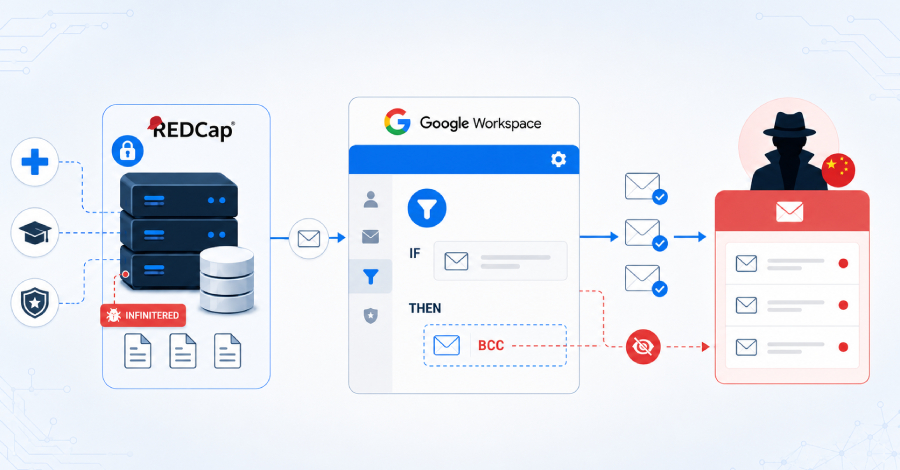
According to Google's investigation, the threat actor initially compromised internet-facing REDCap servers used by research institutions. REDCap is a widely adopted platform for managing research and clinical data.
After gaining access, the attackers escalated privileges and obtained administrative control over affected Google Workspace environments.
Rather than deploying additional malware, UNC6508 configured Google Workspace Content Compliance Rules — a legitimate email management feature designed for enterprise administrators.
These malicious rules automatically:
- Scanned emails for specific keywords
- Monitored communications related to defense, AI, cybersecurity, and research projects
- Silently copied matching emails
- Forwarded them to attacker-controlled email accounts
Because the feature was operating exactly as intended, the activity generated little to no suspicious network traffic, allowing the attackers to evade many traditional security tools.
What Data Was Targeted?
Google reports that the espionage campaign focused on collecting highly sensitive information, including:
- National defense research
- Artificial intelligence projects
- Cybersecurity programs
- Military operations data
- Medical and healthcare research
- Academic research initiatives
Investigators believe the attackers maintained access to some environments from September 2023 through late 2025 before being discovered.
Why This Attack Is Significant
The campaign highlights a growing trend in modern cyber espionage where attackers abuse trusted cloud services instead of deploying custom malware.
Security experts often focus on detecting malicious executables, command-and-control servers, and suspicious network activity. However, when threat actors leverage legitimate administrative features within cloud platforms, detection becomes significantly more challenging.
This technique demonstrates how attackers can transform everyday enterprise tools into covert data exfiltration channels.
Google's Response
Following the discovery, Google disabled the attacker-controlled accounts involved in the operation and published indicators of compromise (IOCs) to assist defenders.
Google also urged organizations to:
- Audit Google Workspace Content Compliance Rules
- Review email forwarding configurations
- Monitor administrative activity logs
- Investigate unusual mail routing changes
- Secure externally exposed REDCap servers
- Enforce phishing-resistant multi-factor authentication (MFA)
The company emphasized that organizations should regularly review administrative policies within cloud environments, as misused native features can be just as dangerous as malware.
Security Lessons for Organizations
The UNC6508 campaign serves as a critical reminder that cloud security extends beyond endpoint protection.
Organizations should:
1. Audit Administrative Rules Regularly
Review Workspace content compliance, mail routing, and forwarding rules for unauthorized changes.
2. Monitor Privileged Accounts
Implement continuous monitoring for administrator accounts and privileged actions.
3. Secure Research Infrastructure
Patch and update publicly accessible research platforms such as REDCap.
4. Enable Strong MFA
Deploy phishing-resistant authentication methods such as hardware security keys.
5. Review Audit Logs Frequently
Investigate any unexpected modifications to email policies or administrative settings.
The Bigger Picture
As enterprises increasingly migrate critical operations to cloud platforms, attackers are adapting their tactics accordingly. Rather than exploiting software vulnerabilities alone, modern espionage groups are weaponizing legitimate cloud features to blend into normal business operations.
The UNC6508 campaign demonstrates that even trusted administrative tools can become powerful weapons when placed in the wrong hands.
For defenders, visibility into cloud configurations and administrative actions is becoming just as important as traditional malware detection.
Conclusion
The discovery of UNC6508's abuse of Google Workspace rules marks another evolution in state-sponsored cyber espionage. By turning legitimate enterprise features into stealthy surveillance mechanisms, the attackers were able to collect sensitive research and defense-related information while remaining largely undetected.
Organizations relying on cloud-based collaboration platforms must now treat administrative configurations as critical security assets and continuously monitor them for abuse.