Newly Disclosed Linux Privilege Escalation Flaw Allows Attackers to Gain Root Access Within Seconds
A newly disclosed Linux privilege escalation vulnerability, dubbed "DirtyClone," has raised serious concerns across the cybersecurity community after researchers demonstrated that it can allow local attackers to obtain instant root access on vulnerable Linux systems.
The exploit targets a flaw in the Linux kernel's memory management mechanisms, enabling an unprivileged local user to escalate privileges and gain complete administrative control over the affected machine. Security researchers warn that while the vulnerability requires local access, it poses a significant threat in multi-user environments, cloud infrastructure, enterprise servers, and developer workstations where attackers may already have limited system access.
The discovery once again highlights the critical importance of timely patch management and kernel security for Linux-based environments.
What Is DirtyClone?
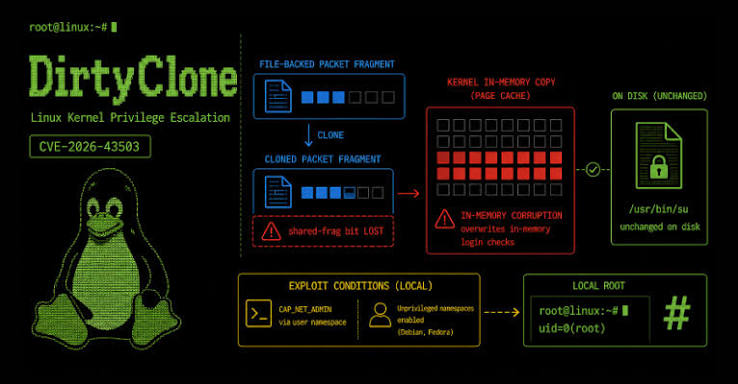
DirtyClone is a local privilege escalation (LPE) vulnerability affecting the Linux kernel.
Unlike remote code execution vulnerabilities, DirtyClone cannot be exploited directly over the internet. However, once an attacker gains even minimal access to a vulnerable Linux system—through stolen credentials, compromised services, or another vulnerability—they can exploit DirtyClone to elevate their privileges to root, effectively taking full control of the system.
Researchers describe the exploit as reliable and fast, allowing attackers to bypass normal privilege boundaries and execute arbitrary code with the highest level of system permissions.
How the Exploit Works
DirtyClone abuses weaknesses in Linux kernel memory handling to manipulate privileged operations.
By carefully crafting memory operations, an attacker can:
- Escalate from a standard user account to root.
- Execute arbitrary commands with full administrative privileges.
- Modify protected system files.
- Install persistent malware or backdoors.
- Disable security monitoring tools.
- Create hidden administrator accounts.
Because the exploit occurs entirely on the local system, traditional network-based security controls may not detect the attack.
Why This Vulnerability Matters
Privilege escalation vulnerabilities are among the most dangerous weaknesses in modern operating systems.
Although DirtyClone requires local access, attackers frequently chain privilege escalation exploits with other attack techniques, including:
- Phishing campaigns
- Stolen SSH credentials
- Web application compromise
- Container escapes
- Supply chain attacks
- Insider threats
Once root access is obtained, attackers can move laterally, steal sensitive data, disable security controls, or deploy ransomware.
Potential Impact
Successful exploitation could allow attackers to:
- Gain complete root privileges.
- Access confidential files and databases.
- Disable endpoint protection software.
- Install persistent malware.
- Manipulate system logs to hide malicious activity.
- Pivot to additional systems within the network.
Organizations operating shared Linux servers, cloud workloads, research environments, and development infrastructure may face elevated risk if systems remain unpatched.
Who Could Be Affected?
Any organization relying on Linux infrastructure should evaluate its exposure.
Potentially affected environments include:
- Enterprise Linux servers
- Cloud virtual machines
- Kubernetes worker nodes
- Web hosting platforms
- DevOps environments
- University computing clusters
- Shared Linux workstations
Because Linux powers a significant portion of global cloud infrastructure, timely remediation is essential.
Recommended Mitigation Steps
Security teams should take immediate action to reduce risk.
1. Apply Security Updates
Install vendor-provided kernel updates as soon as they become available.
2. Restrict Local Access
Limit shell access to trusted users and disable unused accounts.
3. Enable Least Privilege
Ensure users have only the permissions necessary to perform their tasks.
4. Monitor Privilege Escalation
Deploy Endpoint Detection and Response (EDR) or Linux security monitoring tools capable of detecting abnormal privilege changes.
5. Audit User Accounts
Review administrative accounts and investigate unexpected privilege assignments.
6. Strengthen Authentication
Use multi-factor authentication (MFA) for administrative access and secure remote login mechanisms.
Why Linux Privilege Escalation Flaws Are So Dangerous
Linux is widely used to power:
- Cloud infrastructure
- Enterprise servers
- Financial systems
- Telecommunications networks
- Government services
- Supercomputers
- Internet-facing applications
A local privilege escalation flaw like DirtyClone can transform a minor compromise into a full system takeover, making it especially valuable for ransomware operators and advanced persistent threat (APT) groups.
The Bigger Picture
Cybercriminals increasingly chain multiple vulnerabilities together to achieve complete system compromise.
An attacker may first obtain low-level access through phishing, exposed services, or credential theft before using a local privilege escalation exploit like DirtyClone to gain root privileges.
This trend underscores the importance of defense-in-depth strategies that combine patch management, endpoint monitoring, access controls, and continuous threat detection.
Conclusion
The discovery of the DirtyClone exploit serves as another reminder that local privilege escalation vulnerabilities remain a critical component of modern cyberattacks.
Although the flaw requires local access, its ability to grant instant root privileges makes it highly valuable to threat actors seeking to compromise Linux systems.
Organizations should prioritize kernel updates, review privileged access, and strengthen monitoring capabilities to reduce the risk of exploitation. In today's threat landscape, even a limited foothold on a Linux machine can quickly escalate into a complete system compromise if privilege escalation vulnerabilities are left unpatched