Microsoft Defender Faces New Zero-Day Threat
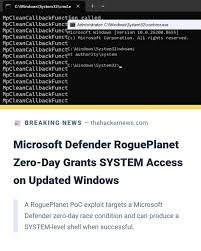
A newly disclosed Windows Defender zero-day vulnerability known as RoguePlanet is raising concerns across the cybersecurity community after researchers demonstrated that the exploit can grant attackers SYSTEM-level privileges on fully updated Windows 10 and Windows 11 systems.
The proof-of-concept (PoC) exploit was publicly released by security researcher Nightmare Eclipse, also known as Chaotic Eclipse, just hours after Microsoft's June 2026 Patch Tuesday rollout. The disclosure has intensified discussions around vulnerability handling, patch effectiveness, and the growing number of publicly released Windows zero-days.
What Is RoguePlanet?
RoguePlanet is a local privilege escalation (LPE) vulnerability that reportedly exploits a race condition within Microsoft Defender's file-processing and quarantine mechanisms.
According to published technical analyses, the flaw allows an attacker with local access to elevate privileges from a standard user account to NT AUTHORITY\SYSTEM, the highest privilege level available on Windows systems.
If successfully exploited, attackers could:
- Execute arbitrary code with SYSTEM privileges
- Disable security controls
- Install malware or ransomware
- Access sensitive system data
- Establish persistence mechanisms
- Move laterally within enterprise environments
Researchers claim the vulnerability works even on systems that have installed the latest June 2026 security updates.
How the Exploit Works
Technical reports indicate that RoguePlanet abuses a Time-of-Check to Time-of-Use (TOCTOU) race condition within Microsoft Defender.
The exploit leverages legitimate Windows components, including:
- Microsoft Defender scanning operations
- NTFS directory junctions
- Volume Shadow Copy Services (VSS)
- Windows Error Reporting (WER)
- File redirection techniques
By carefully manipulating file operations during Defender's scanning process, attackers can reportedly trick the operating system into executing malicious code with elevated privileges.
Importantly, no kernel exploit or memory corruption vulnerability is required, making the attack particularly noteworthy from a defensive standpoint.
Independent Validation Confirms Threat
Several cybersecurity researchers and security vendors have independently reviewed the exploit and confirmed that it functions as described under certain conditions.
ThreatLocker researchers reported that the exploit is viable, although success rates may vary depending on system configuration and timing conditions. Because the flaw relies on a race condition, exploitation is not always guaranteed but can reportedly achieve high success rates on some systems.
Security experts emphasize that while the attack requires local execution, it could become extremely dangerous when combined with phishing attacks, malware infections, or compromised user accounts.
Why This Matters
Privilege escalation vulnerabilities remain one of the most valuable tools in an attacker's arsenal.
Even if an attacker initially gains only limited access to a system, vulnerabilities such as RoguePlanet can enable full system compromise.
The emergence of RoguePlanet highlights a growing trend where attackers target trusted security products themselves, turning defensive technologies into attack vectors.
For organizations relying heavily on Microsoft Defender as their primary endpoint protection platform, the disclosure serves as a reminder that security tools can also become targets.
Microsoft's Response
Microsoft has acknowledged previous disclosures from the same researcher and has patched several earlier vulnerabilities. At the time of writing, the company is reportedly investigating the RoguePlanet exploit and evaluating mitigation options.
Security teams should monitor Microsoft's official security advisories for updates, patches, or additional guidance.
Until a permanent fix becomes available, organizations are encouraged to implement layered defenses and monitor for suspicious privilege escalation activity.
Recommended Mitigations
Security teams should consider the following defensive measures:
Enable Application Allowlisting
Application allowlisting can prevent unauthorized binaries from executing and may block exploitation attempts.
Monitor Privilege Escalation Events
Review logs for unexpected SYSTEM-level process creation and unusual Defender-related activity.
Deploy Attack Surface Reduction (ASR) Rules
Microsoft's Attack Surface Reduction policies can help limit exploit execution pathways.
Restrict Local Execution
Minimize opportunities for attackers to run untrusted code on endpoints.
Maintain Endpoint Visibility
Use Endpoint Detection and Response (EDR) tools to identify suspicious privilege escalation behavior.
Growing Tensions Over Vulnerability Disclosure
RoguePlanet marks the latest in a series of publicly released Windows vulnerabilities attributed to Nightmare Eclipse.
The researcher has publicly criticized Microsoft's vulnerability disclosure process, claiming previous reports were not handled appropriately. In response, multiple exploit repositories hosting the researcher's proof-of-concept code were reportedly removed.
The ongoing dispute has become a major talking point within the cybersecurity community, raising questions about responsible disclosure practices and vendor-researcher relationships.
Conclusion
The disclosure of RoguePlanet demonstrates that even fully patched systems can remain vulnerable to previously unknown attack techniques. While exploitation currently requires local access, the ability to obtain SYSTEM-level privileges makes the vulnerability highly valuable to threat actors.
Organizations should closely monitor Microsoft's response, strengthen endpoint protections, and implement layered security controls until a comprehensive patch becomes available.
As cyber threats continue evolving, RoguePlanet serves as another reminder that defensive technologies themselves can become targets in the ongoing cybersecurity arms race.