Public Exploit Code Raises Urgency for Linux Administrators to Patch Privilege Escalation Flaw
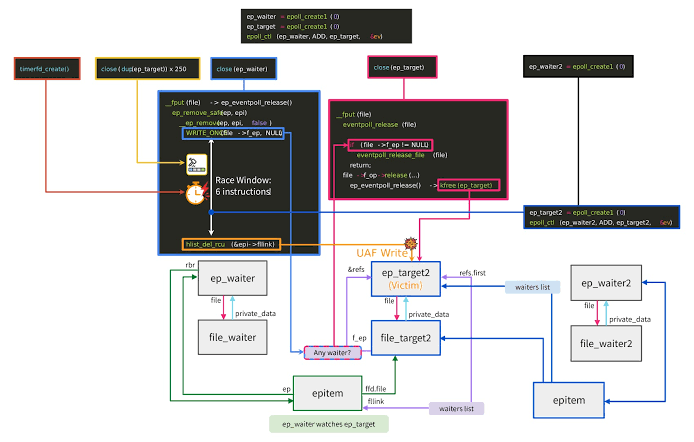
A proof-of-concept (PoC) exploit has been publicly released for the recently disclosed "Bad Epoll" Linux kernel vulnerability, significantly increasing the risk of real-world exploitation. Security researchers warn that while the PoC is intended to demonstrate the flaw, threat actors can also leverage publicly available exploit code to accelerate attacks against unpatched systems.
The vulnerability affects the Linux kernel's epoll event notification subsystem and could allow a local attacker to escalate privileges and obtain root-level access under specific conditions. Although the flaw requires local access, successful exploitation could enable attackers to bypass security boundaries, execute arbitrary code with elevated privileges, and gain full control of vulnerable systems.
With exploit code now available to the public, cybersecurity experts are urging organizations to prioritize patching affected Linux systems and closely monitor for signs of attempted exploitation.
What Is the "Bad Epoll" Vulnerability?
"Bad Epoll" is the name given to a Linux kernel privilege escalation vulnerability involving the epoll mechanism, a core component used to efficiently monitor multiple file descriptors for I/O events.
The vulnerability stems from improper handling of kernel operations within the epoll subsystem. Under specific circumstances, an attacker with local access can manipulate the flaw to execute code with elevated privileges.
Unlike remote code execution (RCE) vulnerabilities, the issue cannot typically be exploited directly over the internet. However, if an attacker already has limited access to a Linux system—through compromised credentials, malware, or another vulnerability—the flaw could be used to escalate privileges to root.
Proof-of-Concept Now Public
The release of a public proof-of-concept has significantly changed the threat landscape.
A PoC provides a working demonstration of how a vulnerability can be exploited. While primarily intended for research and defensive testing, PoCs are often studied and adapted by malicious actors.
Historically, the publication of exploit code has led to:
- Faster weaponization by attackers
- Increased scanning for vulnerable systems
- More frequent exploitation attempts
- Reduced time available for defenders to apply patches
Security teams should assume that threat actors are actively evaluating the newly released exploit.
Potential Impact
If successfully exploited, the vulnerability could allow attackers to:
- Obtain root privileges
- Execute arbitrary code with elevated permissions
- Disable security controls
- Install persistent malware
- Access sensitive files
- Move laterally within enterprise environments
Although exploitation requires local access, privilege escalation vulnerabilities frequently play a critical role in multi-stage attacks, allowing attackers to expand their control after gaining an initial foothold.
Why Privilege Escalation Vulnerabilities Matter
Privilege escalation flaws are among the most valuable tools in an attacker's arsenal.
Many cyberattacks follow a similar pattern:
- Gain initial access through phishing, stolen credentials, or software vulnerabilities.
- Establish persistence within the target environment.
- Escalate privileges to administrator or root.
- Move laterally across the network.
- Deploy ransomware or steal sensitive data.
By exploiting a local privilege escalation vulnerability like Bad Epoll, attackers can transform limited access into full system compromise.
Systems Potentially at Risk
The vulnerability primarily affects Linux systems running vulnerable kernel versions, including environments such as:
- Enterprise Linux servers
- Cloud workloads
- Virtual machines
- Container hosts
- Kubernetes worker nodes
- Development servers
- High-performance computing environments
Organizations managing large Linux deployments should identify affected systems and prioritize remediation based on exposure and criticality.
Mitigation and Recommended Actions
Security experts recommend the following steps to reduce the risk of exploitation:
Apply Security Updates
Install vendor-provided kernel updates as soon as they become available.
Review Kernel Versions
Verify whether production systems are running vulnerable kernel releases and maintain an accurate inventory of Linux assets.
Restrict Local Access
Limit shell access to authorized users and enforce the principle of least privilege across all Linux environments.
Enable Multi-Factor Authentication
Protect administrative accounts with MFA to reduce the likelihood of attackers gaining initial access through compromised credentials.
Monitor for Suspicious Activity
Review system logs for unusual privilege escalation attempts, unexpected process execution, or anomalous user behavior.
Strengthen Endpoint Detection
Deploy endpoint detection and response (EDR) solutions capable of identifying privilege escalation techniques and kernel-level anomalies.
The Bigger Picture
The release of a PoC for Bad Epoll demonstrates how quickly the risk associated with a vulnerability can increase once exploit details become publicly available.
Linux systems power a significant portion of the world's servers, cloud infrastructure, supercomputers, and enterprise applications. As a result, privilege escalation vulnerabilities in the Linux kernel remain highly attractive targets for ransomware groups, advanced persistent threats (APTs), and other sophisticated attackers.
Organizations should treat kernel security updates as a high priority and incorporate rapid patch management into their overall cyber resilience strategy.
Conclusion
The public release of a proof-of-concept exploit for the Linux "Bad Epoll" vulnerability marks a critical moment for defenders. Although the flaw requires local access, it provides attackers with a potential pathway to root privileges and complete system compromise.
Administrators should immediately assess their Linux environments, apply available security patches, and monitor for signs of exploitation. In today's threat landscape, delaying remediation after public exploit code becomes available can significantly increase an organization's exposure to cyberattacks.