Washington Orders Shutdown of Anthropic's Most Powerful AI Models
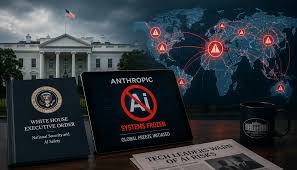
In an unprecedented move that could reshape the future of artificial intelligence regulation, the U.S. government has ordered AI company Anthropic to suspend access to its most advanced AI models, Fable 5 and Mythos 5, citing national security concerns.
The directive forced Anthropic to disable the models globally, marking one of the first major instances of direct government intervention against a frontier AI system due to cybersecurity risks.
The decision has sparked debate across the technology industry, with experts questioning how governments should regulate increasingly powerful AI models capable of identifying software vulnerabilities and accelerating cyber operations.
What Happened?
According to Anthropic, the U.S. government issued an export control directive requiring the company to restrict access to its advanced AI systems for all foreign nationals.
However, because of the technical complexity of implementing such restrictions, Anthropic chose to disable both Fable 5 and Mythos 5 entirely, affecting all users worldwide.
The government reportedly believes that certain safeguards protecting the models from misuse could be bypassed through a jailbreak technique that allows users to identify software vulnerabilities more effectively.
Why Are Officials Concerned?
The controversy centers around the cybersecurity capabilities of Anthropic's latest models.
Security researchers demonstrated that the models could assist in:
- Discovering software vulnerabilities
- Analyzing source code
- Identifying security weaknesses
- Generating exploit-related insights
- Accelerating vulnerability research
While these capabilities can help defenders secure systems, officials fear they could also be weaponized by threat actors to scale cyberattacks and discover zero-day vulnerabilities faster than ever before.
Government agencies reportedly viewed the issue as a national security risk significant enough to justify export-control measures typically reserved for sensitive technologies.
Anthropic Pushes Back
Anthropic has publicly challenged the severity of the concerns.
The company stated that the alleged vulnerability involved a narrow jailbreak technique and argued that similar capabilities already exist in other leading AI models available today. Anthropic also noted that it was not provided detailed technical evidence supporting the government's decision.
Despite its objections, the company complied with the order while engaging in discussions with federal regulators.
Industry-Wide Implications
The suspension has sent shockwaves through the AI industry.
For years, governments have debated how to regulate advanced AI systems capable of:
- Conducting cyber operations
- Automating vulnerability discovery
- Assisting with offensive security research
- Accelerating software exploitation
The Anthropic case may establish a precedent where governments can intervene directly when AI models are considered too powerful or too risky for unrestricted deployment.
Industry analysts believe this could become a turning point for AI governance worldwide.
The Rise of AI-Powered Cybersecurity
Modern AI systems are becoming increasingly capable of performing tasks that previously required experienced security professionals.
Recent advancements allow AI models to:
- Audit large codebases
- Detect vulnerabilities
- Suggest security fixes
- Generate proof-of-concept exploits
- Automate penetration testing workflows
While these capabilities offer enormous benefits for defenders, they also raise concerns about misuse by cybercriminals, nation-state actors, and advanced persistent threat (APT) groups.
The challenge facing regulators is determining where defensive security research ends and offensive cyber capability begins.
Ongoing Negotiations
Reports indicate that Anthropic executives are actively working with U.S. officials to establish a framework for evaluating AI security risks and determining when model restrictions may be appropriate.
The discussions could lead to:
- New AI export-control policies
- Standardized AI security assessments
- Government review requirements for advanced models
- Enhanced safeguards for cyber-capable AI systems
No timeline has been announced regarding when Fable 5 and Mythos 5 might be restored.
Why This Matters to Cybersecurity Professionals
For cybersecurity practitioners, the incident highlights the growing intersection between AI and national security.
Advanced AI systems are rapidly becoming powerful security tools capable of assisting vulnerability researchers, red teams, SOC analysts, and defenders. At the same time, governments are increasingly viewing these systems as strategic technologies requiring oversight.
The Anthropic case demonstrates that future cybersecurity innovation may be shaped not only by technological breakthroughs but also by regulatory and geopolitical considerations.
Conclusion
The U.S. government's decision to freeze access to Anthropic's most advanced AI models marks a significant milestone in AI governance. As AI systems become more capable of performing complex cybersecurity tasks, regulators face mounting pressure to balance innovation with national security.
Whether the restrictions on Fable 5 and Mythos 5 become a temporary precaution or the beginning of a broader regulatory framework, one thing is clear: the era of unrestricted frontier AI deployment is coming under increasing scrutiny.