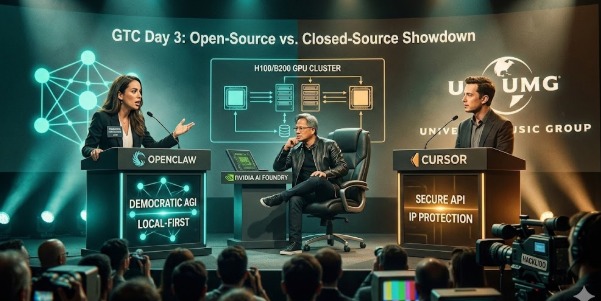
The atmosphere at the San Jose McEnery Convention Center shifted from "product launch" to "philosophical debate" today. At 12:30 PM PDT, NVIDIA CEO Jensen Huang stepped away from the hardware spotlight to moderate the week's most anticipated panel: "Open Models: Where We Are and Where We're Headed."
1. The Contenders: A High-Stakes Fireside Chat
The panel brought together the biggest names currently shaping the AI landscape.
- The Open Source Vanguard: Harrison Chase (LangChain) and Mira Murati (now CEO of Thinking Machines Lab). They argued that open models are the only path to a democratic AGI, citing the meteoric rise of OpenClaw—which Jensen himself called "the most popular open-source project in human history" earlier this week.
- The Closed-Source Giants: Representatives from Cursor and Universal Music Group (Sir Lucian Grainge). Their focus remained on safety, intellectual property, and the necessity of centralized APIs to prevent "unaligned" frontier models from being deployed without guardrails.
- The Moderator: Jensen Huang, positioning NVIDIA as "vertically integrated but horizontally open," attempted to bridge the gap, noting that NVIDIA’s stack must support both "Sovereign AI" (local/open) and "Cloud AI Factories" (centralized).
2. The "OpenClaw" Factor: The Operating System of Agents
For the Hacklido community, the biggest takeaway was the validation of OpenClaw.
- The "Personal Agent" Dream: OpenClaw has effectively become the "Linux of Agents." Jensen highlighted that with a single command, developers can now pull down OpenClaw and stand up a proactive AI agent that runs entirely on local accelerated hardware—like GeForce RTX laptops or the new DGX Station Spark.
- NVIDIA’s Support: In a major win for open-source, NVIDIA announced native support for OpenClaw across its entire platform, making it the default framework for building "always-on" AI assistants.
3. Strategic Partnerships: Thinking Machines & Cursor
The debate was made even more interesting by NVIDIA’s recent financial moves:
- Thinking Machines Lab: NVIDIA recently finalized a gigawatt-scale strategic partnership and investment in Mira Murati’s new venture. They are deploying massive Vera Rubin clusters to train next-gen open models.
- Cursor: On the flip side, NVIDIA participated in Cursor’s funding round in November, acknowledging the efficiency of their closed-source, deeply integrated AI coding environment.
Hacklido Technical Takeaway: Choosing Your Side
If you are managing an engineering team or building your own "Claw," here is how to navigate today's announcements:
- The Case for Open (OpenClaw/Thinking Machines): Use this if your priority is Data Sovereignty or offline functionality. If you need to "shape AI to your own potential" (as Mira Murati put it), the open-source stack is now production-ready on NVIDIA hardware.
- The Case for Closed (Cursor/Centralized APIs): Use this if you need Turnkey Safety and the absolute highest reasoning capabilities without managing infrastructure. For high-speed, secure coding, Cursor remains the "gold standard" of integration.
Local First Validation: Jensen’s mention of DGX Spark as the "ideal environment" for validating agents locally before scaling to the cloud is a massive signal. Always validate locally.