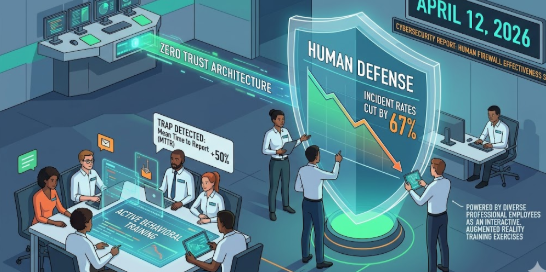
A landmark study released today, the 2025-2026 Global Security Awareness Report, has revealed a startling shift in the efficacy of corporate defense. While the sophistication of AI-driven attacks has skyrocketed, organizations that have implemented structured, behavior-based security training programs have seen a massive 67% reduction in successful cyber incidents.
For the Hacklido community, where we often focus on the "perfect exploit," this data serves as a sobering reminder: the human firewall is finally being patched.
1. The "Behavioral" Pivot
The report highlights that the traditional "compliance-based" training the once-a-year slideshow and quiz is officially dead. The most successful organizations have shifted toward Active Defense Training.
- Micro-Simulations: Instead of warnings, employees are subjected to hyper-realistic, AI-generated phishing simulations that mirror current zero-day social engineering tactics.
- The "Zero-Second" Feedback Loop: When an employee clicks a simulated malicious link, they aren't just scolded; they receive an immediate, interactive breakdown of the specific "tells" they missed, from spoofed headers to deepfake audio artifacts.
- Quantifiable Metrics: Security teams are now tracking "Mean Time to Report" (MTTR) rather than just "Click Rates," rewarding employees for identifying and reporting threats before they can execute.
2. The AI Paradox: More Fear, More Vigilance
In a strange twist, the rise of "God-mode" AI tools for hackers has actually made the average employee safer. The report found that 90% of workers are now significantly more skeptical of unsolicited communications because they are aware of the existence of deepfakes and automated phishing.
"The 'scare factor' of AI has done more for security awareness in twelve months than a decade of corporate policy ever did," says Dr. Elena Vance, lead researcher of the study. "People now assume that what they see and hear might be fake, which is the foundational mindset of Zero Trust."
3. The Readiness Gap: Leadership vs. Reality
Despite the 67% drop in successful breaches, the report exposes a massive confidence gap at the top:
- Leadership Anxiety: Only 40% of C-suite executives feel their staff could identify a high-end AI-synthesized voice or video call.
- Resource Misallocation: While training shows the highest ROI (Return on Investment), 70% of security budgets are still locked into legacy hardware and software licenses that often fail to catch the social engineering attacks that humans are now blocking.
4. Hacklido Intelligence: The New Attack Surface
As an intelligence portal, we must analyze what this means for the future of offensive security. If the "low hanging fruit" of basic phishing is being eliminated by better training, attackers will naturally pivot to:
- Deep-Level Technical Exploits: Moving away from the human and toward unpatched firmware and kernel-level vulnerabilities.
- Supply Chain Infiltration: Targeting the trusted software developers and administrators who are often exempt from the very training they help deploy.
- Platform Manipulation: Using AI to subvert the training platforms themselves to create a false sense of security.
The Verdict: The "Human Firewall" is no longer a punchline. For red-teamers and researchers, the bar for social engineering has just been raised. Organizations are finally realizing that an educated employee is a more effective deterrent than a million-dollar firewall.