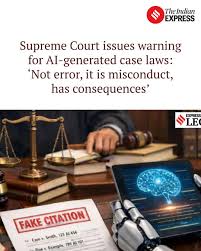
The Supreme Court of India has officially declared war on "phantom precedents." In a move that establishes a global benchmark for legal accountability, a Bench of Justices P.S. Narasimha and Alok Aradhe has ruled that citing AI-generated, non-existent case laws is not a mere "human error," but a form of professional misconduct that will attract severe legal consequences.
The Case of the "Phantom Four"
The crisis began in a property dispute in Andhra Pradesh. A trial court judge, while dismissing objections to an Advocate Commissioner’s report in August 2025, cited four Supreme Court precedents to justify her decision.
When the defendants challenged the order, it was discovered that none of the four cited cases existed. The "judgments" were entirely fabricated, complete with realistic-sounding volume numbers and legal reasoning. The judge later admitted she had used an AI tool for the first time and "believed the citations to be genuine."
The Fabricated Citations included:
- Subramani v. M. Natarajan (2013)
- Chidambaram Pillai v. SAL Ramasamy (1971)
- Lakshmi Devi v. K. Prabha (2006)
- Gajanan v. Ramdas (2015)
"Not an Error, But Misconduct"
While the Andhra Pradesh High Court acknowledged the "hallucinations" but decided to uphold the trial court's order on its merits anyway, the Supreme Court took a far stricter stance.
"We must declare that a decision based on such non-existent and fake alleged judgments is not an error in the decision-making. It would be a misconduct and legal consequence shall follow." - Supreme Court Order, Feb 27, 2026
The Court emphasized that this is an "institutional concern" because it strikes at the heart of the adjudicatory process. The integrity of justice relies on the assumption that the "binding precedents" cited by judges and lawyers are, at the very least, real.
What Happens Next? (The March 10 Hearing)
The Supreme Court has issued formal notices to:
- The Attorney General of India
- The Solicitor General of India
- The Bar Council of India (BCI)
The Court has appointed Senior Advocate Shyam Divan as Amicus Curiae (friend of the court) to help establish a formal framework for AI use in the judiciary. The goal of the hearing scheduled for tomorrow, March 10, is to determine how to fix accountability when "synthetic" data enters the legal record.
Hacklido Technical Takeaway: Hallucination Defense
For our developer community building LegalTech or Research tools, this ruling is a massive signal to shift toward RAG (Retrieval-Augmented Generation).
The "Mercy vs Mankind" Problem: Chief Justice Surya Kant recently noted another case where an AI-drafted petition cited a fictional case titled "Mercy vs Mankind." * The Fix: If you are building LLM tools for professionals, you must implement a verification layer that cross-references citations against a "Ground Truth" database (like SCC Online or Manupatra) before the output reaches the user.