Former OpenAI Employee Accused of Planting Hidden Recording Device
A former OpenAI employee has been arrested in the United States over allegations that he planted a hidden audio recording device in an executive conference room at the company's San Francisco offices to secretly capture confidential conversations.
According to the U.S. Department of Justice (DOJ), Abdulrahman Alfozan, 35, was arrested on October 9, 2026. He has been charged with using or attempting to use an electronic, mechanical, or other device to intercept oral communications.
Alfozan reportedly joined OpenAI in July 2025 as an engineering lead. The company has since terminated his employment.
The allegations concern a concealed recording device allegedly installed in a conference room used for discussions involving confidential technical research, commercial plans, strategic decisions, and other sensitive business information.
How the Hidden Recording Device Was Discovered
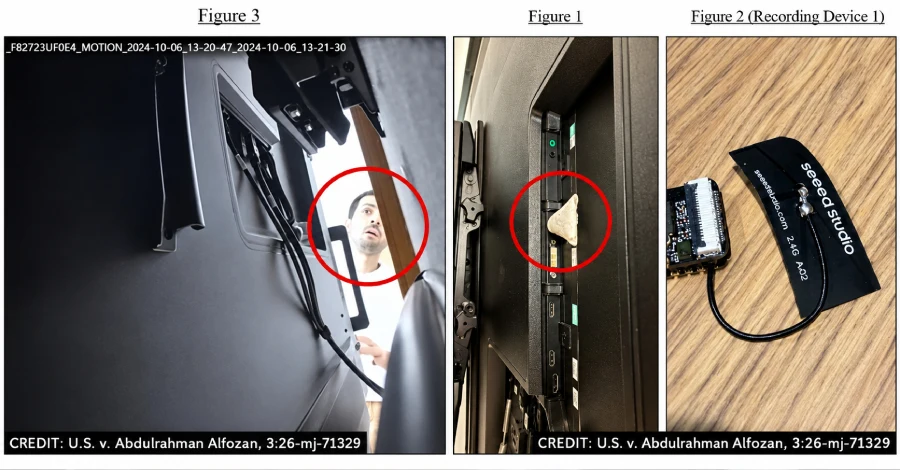
According to the criminal complaint, OpenAI personnel discovered the recording device on or around September 30, 2026. It was reportedly connected to a USB port on the back of a television inside an executive conference room and concealed using toilet paper.
Investigators allege that the device had been installed around September 28.
The conference room was reportedly reserved for meetings involving highly confidential information, including proprietary research, product plans, business-development opportunities, technical progress, government engagements, and commercial relationships.
Authorities are investigating the circumstances surrounding the alleged installation and the intended use of the recording equipment.
Investigation Identifies Alleged Suspicious Activity
The complaint describes several actions that investigators allegedly linked to Alfozan before and after the device was discovered.
CCTV Footage From the Office
According to the complaint, surveillance footage showed Alfozan near the executive conference room on multiple dates before the device was discovered.
Investigators alleged that he had no authorization to access the room or participate in the meetings conducted there.
Collection of Office and Meeting Information
The complaint also alleges that Alfozan used a productivity tool to gather information about OpenAI's office addresses, meeting rooms, room capacities, calendars, executive locations, and external partner meetings.
Authorities are examining how this information may relate to the alleged recording-device installation.
Chatbot Prompts Related to Recording Equipment
Investigators reportedly identified prompts submitted through a chatbot account associated with Alfozan's spouse between September 24 and September 30, 2026.
The prompts allegedly concerned building, customizing, installing, testing, concealing, and remotely accessing an audio-recording device. Other prompts reportedly referenced wireless connectivity, live audio monitoring, and SD card encryption.
The complaint also allegedly connected the account to questions about the device's identifying information, including its custom header and MAC address.
These details form part of the allegations described by prosecutors and do not, by themselves, establish guilt.
A Second Recording Device Allegedly Found
The complaint further alleges that on October 5, 2026, Alfozan entered the executive conference room and appeared to look behind the television where the first device had reportedly been installed.
On the same day, he allegedly left a bag unattended in another room at an OpenAI building. The bag reportedly contained a second recording device, along with his wallet and identification.
Investigators have not publicly established through the allegations alone whether the devices successfully recorded confidential conversations or whether any recordings were transmitted to another party.
OpenAI Says AI Models Helped Investigate the Device
OpenAI said it discovered what it described as a sophisticated recording device and used its own AI models to help understand the device and determine where it had come from.
The company said it referred the matter to the FBI after its investigation indicated that an employee had allegedly planted the equipment.
OpenAI also told TechCrunch that the device contained advanced encryption, audio-monitoring capabilities, and a data-transfer mechanism designed to evade monitoring.
The company stated that it had no indications at that time that the individual had improperly accessed or exfiltrated model weights, source code, or customer data.
The incident highlights how organizations may use AI-assisted analysis as part of internal security investigations, while still relying on investigators and law enforcement to establish the facts.
FBI Investigation and Potential Penalties
The FBI is investigating the allegations concerning the recording device and the alleged interception of oral communications.
If convicted, Alfozan faces a maximum possible penalty of five years in prison, a $250,000 fine, and up to three years of supervised release.
These are potential statutory penalties, not a sentence. The charges remain allegations, and the defendant is presumed innocent unless proven guilty in court.
Why This Case Raises Insider Threat Concerns
The incident highlights the risks organizations face when individuals with legitimate workplace access are suspected of misusing that access.
Insider-threat scenarios can involve physical surveillance equipment, unauthorized access to restricted spaces, misuse of internal information, or attempts to capture confidential discussions.
Organizations can reduce these risks through several security measures:
- Physical access controls: Restrict entry to executive and sensitive meeting rooms.
- Device inspections: Periodically inspect conference-room equipment, USB ports, and other accessible connection points.
- Insider-threat monitoring: Investigate unusual access patterns while following applicable privacy and employment laws.
- Meeting-room security: Establish procedures for inspecting equipment before and after confidential meetings.
- Incident response: Preserve CCTV footage, device evidence, access logs, and relevant communications for authorized investigations.
- Data protection: Apply access controls and monitoring to sensitive research, source code, model assets, and business information.
A layered approach combining physical security, cybersecurity controls, employee-access governance, and incident response can help organizations identify suspicious activity earlier.
Key Takeaway
The arrest of a former OpenAI engineering lead follows allegations that a hidden recording device was planted in an executive conference room to capture confidential conversations. The investigation includes claims about office surveillance footage, information gathering, chatbot prompts, and a second recording device.
OpenAI said it found no indications that model weights, source code, or customer data had been improperly accessed or exfiltrated by the individual. The legal proceedings will determine the outcome of the allegations.
Sources: U.S. Department of Justice, OpenAI, and TechCrunch.
Official DOJ Announcement: