Microsoft Warns of High-Volume Phishing Campaign Using Invisible Unicode Characters to Evade Email Filters
Microsoft has warned of a large-scale phishing campaign that is abusing invisible Unicode characters to bypass email security filters and deliver financial-themed phishing messages to potential victims.
According to Microsoft's Security Research team, attackers are using Unicode Tag characters, which are invisible to normal users, to split important words inside phishing emails and prevent security systems from detecting common financial keywords.
The campaign represents another example of techniques originally associated with AI prompt injection and ASCII smuggling being adapted for traditional cyberattacks.
Microsoft said the activity first emerged in early February 2026 and later entered a high-volume phase that lasted for approximately three months.
What Is ASCII Smuggling?
ASCII smuggling is an evasion technique that uses invisible or non-rendering Unicode characters to hide information inside apparently normal text.
These characters are generally invisible in standard user interfaces, meaning a recipient may see a normal-looking word even though additional Unicode characters have been inserted between its letters.
The technique can create a difference between what a human sees and what automated security systems process.
Microsoft explained that the same concept has previously been associated with AI prompt injection, where hidden instructions can be embedded inside seemingly harmless content.
Threat actors are now adapting the technique to conventional phishing campaigns.
Attackers Abuse Unicode Tags to Hide Phishing Keywords
The campaign specifically abuses characters from the Unicode Tags block, U+E0000 through U+E007F.
This Unicode range contains characters corresponding to printable ASCII characters. For example, certain Unicode Tag characters represent letters such as "A" and "a."
Microsoft noted that the Unicode Tags block was originally intended for language tagging but is now largely deprecated.
Attackers are inserting these invisible characters into financial keywords used in phishing emails.
For example, the word:
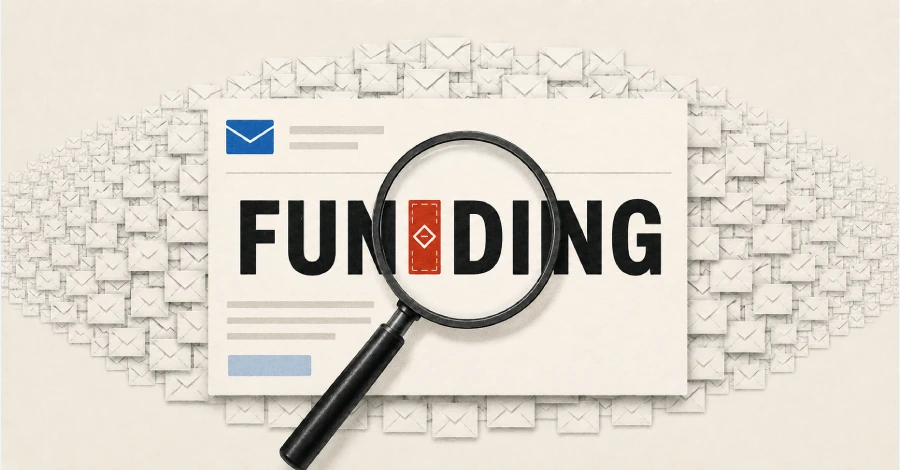
funding
can be transformed into a representation similar to:
fun⟨U+E0020⟩ding
To the recipient, the word can still appear to read as "funding."
However, a security system looking for the exact contiguous string funding may fail to recognize it because an invisible Unicode character has been inserted between the letters.
How the Email Filter Evasion Works
The attack relies on a difference between human-readable text and machine-level processing.
A normal phishing detector may search for specific keywords or use regular expressions to identify suspicious financial language.
When invisible Unicode characters are inserted into those words, the underlying character sequence changes.
For example:
Normal:
funding
Obfuscated:
fun + invisible Unicode character + ding
A detector searching only for the literal string funding may therefore fail to match the obfuscated version.
At the same time, email systems or processing pipelines that remove or normalize the invisible characters may reconstruct the original word.
Microsoft described this as an important distinction between how the content is displayed, normalized, and detected.
Millions of Phishing Emails Sent During Campaign
Microsoft said the campaign reached an exceptionally high volume during its active period.
The activity reportedly followed a distinct weekly pattern.
The campaign was largely inactive during weekends before returning at full scale on Mondays.
During weekdays, Microsoft estimated that the campaign generated between approximately 1 million and 2.37 million messages per day.
The campaign reached its reported peak on February 26, 2026.
After approximately May 15, 2026, the volume dropped sharply.
Financial-Themed Phishing Lures
The phishing campaign primarily used financial-related themes designed to attract businesses and individuals looking for funding.
The messages reportedly imitated legitimate offers involving:
- Business loans
- Business financing
- Lines of credit
- Advance funding
- Financial assistance
- Funding opportunities
The objective of such campaigns can include stealing credentials, collecting sensitive business information, or obtaining financial details.
Microsoft linked the activity to a broader phishing operation that previously abused the ActiveCampaign marketing and automation platform to distribute large numbers of AI-generated phishing messages targeting Small Business Administration (SBA) loan applicants.
Connection to an Earlier ActiveCampaign Phishing Campaign
The broader campaign was previously documented by the Fortra Intelligence and Research Experts (FIRE) team.
Fortra reported in September 2025 that attackers were using ActiveCampaign's marketing automation capabilities to produce large quantities of convincing phishing content.
The operation was designed to collect detailed business and financial information from targeted victims.
That information could potentially be used for future highly targeted spear-phishing operations.
The campaign's use of AI-powered marketing automation allowed attackers to change website designs, content, and user flows at scale.
Hundreds of Disposable Domains Used
Microsoft identified hundreds of disposable domains associated with the campaign.
Many of the domains were designed to look like legitimate financial organizations or funding providers.
Examples identified by Microsoft include:
guardiangrowthfunding[.]comdigitalcapitalboost[.]comthebusinessloanexpress[.]comyourlocfunding[.]comadvancefundingboost[.]comguardiancapitalway[.]comharboradvancefunding[.]comunitedfundingwave[.]comdirectcapitalboost[.]comonlinedirectfinance[.]com
The use of numerous disposable domains makes it more difficult for defenders to rely exclusively on domain reputation or blocklists.
ActiveCampaign Used to Relay Phishing Emails
Another important element of the campaign is the use of ActiveCampaign to relay the phishing emails.
Links contained within the messages were routed through ActiveCampaign's click-tracking infrastructure.
Microsoft identified tracking domains including:
acemlnd[.]comactivehosted[.]com
This infrastructure can make malicious campaigns more difficult to distinguish from legitimate marketing traffic.
Reputable email marketing platforms generally have established IP reputation and authentication mechanisms.
As a result, malicious traffic sent through compromised or abused accounts can potentially inherit some of the trust associated with the legitimate service.
Why Reputation-Based Filtering Can Fail
Email security systems frequently use reputation signals to determine whether a message is legitimate.
These signals can include:
- Sender reputation
- IP reputation
- Domain reputation
- Email authentication
- Sending infrastructure
- Historical sending behavior
Microsoft warned that attackers abusing established marketing platforms can make this process more complicated.
A malicious email originating through a legitimate platform may appear more similar to normal marketing traffic than an email sent directly from newly created attacker infrastructure.
This creates an additional challenge for traditional reputation-based filtering.
ActiveCampaign Responds to the Campaign
ActiveCampaign said it had tested its content moderation systems against messages containing invisible Unicode characters.
According to the company, messages containing these characters receive moderation decisions consistent with their unobfuscated equivalents.
ActiveCampaign also said that extensive use of invisible Unicode characters is treated as a suspicious signal.
This suggests that platform-level detection mechanisms are being adapted to account for Unicode-based obfuscation.
AI-Era Evasion Techniques Moving Into Traditional Phishing
The campaign demonstrates how techniques developed or discussed in the context of AI security can have implications beyond AI systems.
ASCII smuggling became particularly relevant to security researchers because invisible Unicode characters can be used to manipulate how content is interpreted by humans and AI systems.
Attackers are now applying the same general concept to conventional email security.
Instead of hiding instructions from an AI model, the attackers are using invisible characters to interfere with automated phishing detection.
Microsoft described the development as evidence that AI-era evasion techniques are increasingly crossing over into traditional phishing and spam operations.
Why This Phishing Campaign Is Dangerous
The scale of the campaign is one of its most significant characteristics.
Sending millions of messages allows attackers to test different combinations of:
- Domains
- Email content
- Financial keywords
- Sender identities
- Landing pages
- Tracking infrastructure
- Unicode obfuscation techniques
The use of AI-generated content and marketing automation can further reduce the effort required to create convincing phishing campaigns.
The combination of high-volume delivery, disposable infrastructure, financial lures, Unicode obfuscation, and trusted third-party services creates a difficult detection challenge for organizations.
How Organizations Can Defend Against Unicode-Based Phishing
Organizations should avoid relying exclusively on exact keyword matching when detecting phishing emails.
Security teams should consider implementing Unicode normalization and inspection mechanisms capable of identifying suspicious invisible characters.
Defensive measures can include:
- Detecting unexpected Unicode characters in email content
- Normalizing Unicode before keyword and security analysis
- Flagging excessive use of invisible or non-rendering characters
- Inspecting suspicious financial-themed domains
- Monitoring newly registered or disposable domains
- Analyzing redirect and tracking infrastructure
- Strengthening email authentication controls
- Combining reputation-based detection with behavioral analysis
- Training employees to verify financial offers independently
- Monitoring links that redirect through third-party marketing platforms
Security teams should also examine whether their email security products correctly process characters from the Unicode Tags block.
Key Takeaways
The Microsoft investigation highlights an important evolution in phishing techniques.
Attackers are no longer relying only on traditional spelling changes, malicious attachments, or look-alike domains. Invisible Unicode characters can be inserted into otherwise normal-looking text to create a gap between what users see and what security systems detect.
The campaign reportedly reached 1 million to 2.37 million messages per weekday, demonstrating how easily the technique can be scaled when combined with automated infrastructure.
The activity also demonstrates the growing overlap between AI security techniques and conventional cybercrime.
As threat actors continue to adopt techniques originally associated with AI prompt injection and content manipulation, email security systems will need to account for increasingly sophisticated forms of text-level evasion.