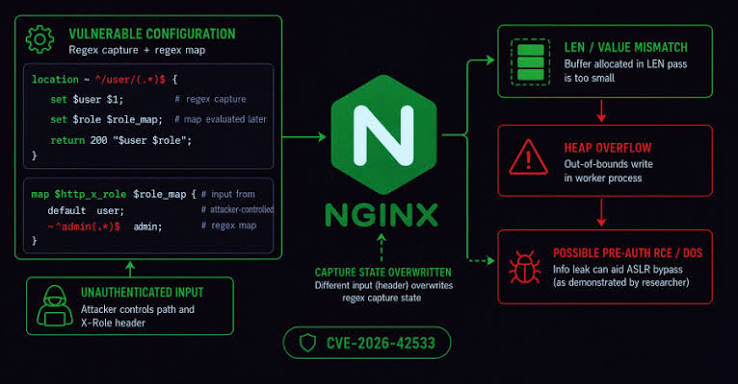
Security researchers have disclosed a critical vulnerability in NGINX that can cause worker processes to crash and, under certain conditions, may allow Remote Code Execution (RCE). As one of the world's most widely used web servers and reverse proxies, a flaw in NGINX could have significant implications for organizations relying on it to host websites, APIs, and enterprise applications.
The vulnerability may allow attackers to send specially crafted requests that trigger worker process crashes, resulting in service disruption. Researchers also warn that specific deployment configurations could increase the risk of remote code execution, potentially allowing attackers to execute arbitrary code on affected servers. Administrators are advised to review vendor security advisories and apply the latest patches or mitigations as soon as they become available.
Recommended Security Measures
Organizations using NGINX should:
Update to the latest patched version immediately.
Review exposed internet-facing NGINX instances.
Monitor server logs for unusual requests or crashes.
Restrict unnecessary public access where possible.
Enable Web Application Firewalls (WAFs) and intrusion detection tools to help identify exploitation attempts.
Why It Matters
NGINX powers millions of websites, cloud platforms, and enterprise applications worldwide. A critical vulnerability affecting its core functionality could expose organizations to service outages, unauthorized access, or potential server compromise if left unpatched.
Conclusion
The newly disclosed NGINX vulnerability highlights the importance of timely patch management and continuous monitoring for internet-facing infrastructure. Organizations should prioritize updates, assess their exposure, and implement recommended security controls to minimize the risk of exploitation.