Google Warns of AI-Powered Cyberattacks Using Autonomous Offensive Frameworks
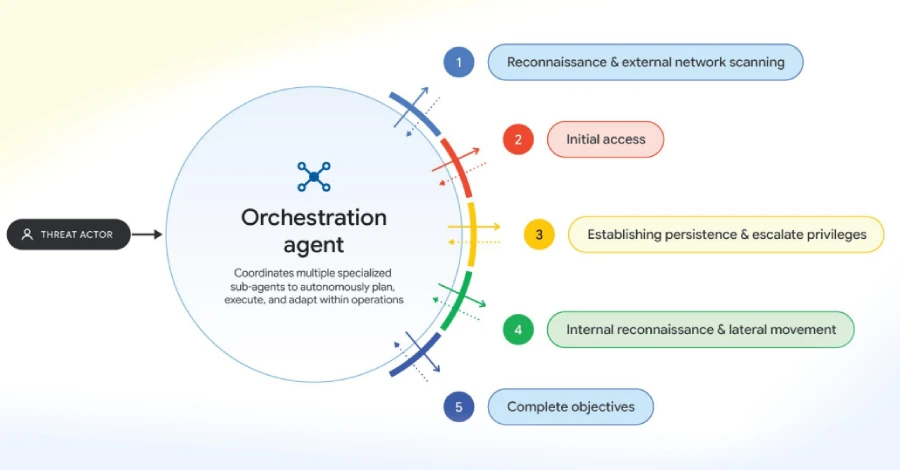
Google has warned that threat actors are increasingly using artificial intelligence (AI) to conduct cyberattacks, moving beyond manually prompting AI tools to deploying autonomous, multi-agent offensive frameworks capable of executing complex intrusion operations.
According to the Google Threat Intelligence Group (GTIG), attackers are experimenting with frameworks such as ARTEX, CAIRN, CyberStrikeAI, and PentAGI to automate different stages of cyberattacks and execute multi-step operations at significantly greater speed.
The growing adoption of these tools represents a shift toward attacks operating at machine speed, allowing threat actors to coordinate multiple attack paths and scale their operations while relying on established cybercriminal techniques.
Google has observed experimentation involving financially motivated groups and suspected espionage actors aligned with China.
Threat Actors Are Adopting Autonomous AI Frameworks
Open-source agentic penetration-testing frameworks are increasingly being used to automate specific operational tasks during active intrusions.
Unlike conventional AI assistants that primarily respond to individual prompts, agentic frameworks can connect large language models (LLMs) with external tools, execute commands, analyze results, and determine subsequent actions.
Google also identified the use of additional tools and services, including:
- ZeroHollow: An inference service used for exploit development and LLM routing.
- Agent Zero: An open-source agent framework supporting autonomous code execution and dynamic tool generation.
These capabilities allow attackers to automate individual stages of an intrusion and connect them into larger attack workflows.
AI Accelerates Vulnerability Research and Exploit Development
Another major concern highlighted by Google is the use of LLM-driven pipelines to automate vulnerability analysis and proof-of-concept (PoC) development.
Threat actors are using AI to perform differential analysis, comparing software versions to identify security changes and understand how vulnerabilities were fixed.
This can help attackers reverse engineer security patches and develop exploits for vulnerabilities that have already been disclosed but remain unpatched across vulnerable systems.
Google noted that attackers can use a relatively limited set of research materials, including:
- Source code from previous and updated software versions.
- Pre-release and preview software builds.
- Security advisories and release notes.
- Public vulnerability research.
- Existing proof-of-concept exploit code.
By automating this analysis, attackers can reduce the time between a vulnerability disclosure and the development of a working exploit.
The trend was also observed in attacks involving PaperCut NG/MF vulnerabilities earlier in September, where attackers reportedly used AI to accelerate the weaponization of patched security flaws.
LLMjacking: Stolen AI Infrastructure Becomes a Criminal Business
Google also highlighted the growing abuse of enterprise AI infrastructure through attacks known as LLMjacking.
In these operations, attackers steal LLM credentials and compromise cloud resources belonging to organizations. Instead of using the infrastructure only for their own activities, they can resell access through underground proxy services.
Platforms such as APIMart and JetNight have been identified as examples of services involved in this underground market, offering discounted access to compromised AI resources. These services are sometimes described as LLM mixers.
This creates an additional financial incentive for attackers to compromise enterprise environments, as stolen AI access can be monetized and reused by other customers.
AI-Powered Phishing Platforms Lower the Barrier for Attackers
The misuse of AI is also changing the phishing-as-a-service (PhaaS) ecosystem.
Google identified a Chinese-language phishing platform called Jieyou, which has integrated an LLM-powered chatbot assistant.
The chatbot allows customers to configure phishing panels and modify existing templates using natural language instructions.
This means affiliates with limited technical knowledge can customize phishing interfaces and deceptive messages without manually editing payloads or understanding the underlying implementation.
Google described this development as part of a broader trend in which PhaaS providers use LLMs as modular force multipliers.
By introducing conversational AI into phishing platforms, operators can make attack customization more accessible to less experienced cybercriminals.
What This Means for Cybersecurity Teams
Google's findings highlight how AI is accelerating several established stages of cyberattacks, including reconnaissance, vulnerability research, exploit development, phishing, and access to compromised infrastructure.
Organizations should consider strengthening their defenses in the following areas:
- Patch management: Prioritize security updates and reduce the time between vulnerability disclosure and patch deployment.
- Vulnerability monitoring: Monitor newly disclosed vulnerabilities and investigate suspicious activity targeting recently patched software.
- Cloud credential security: Protect API keys, cloud credentials, and LLM access tokens using strong authentication and least-privilege permissions.
- AI infrastructure monitoring: Monitor unusual LLM API consumption, unexpected access patterns, and suspicious use of cloud resources.
- Phishing protection: Train employees to recognize convincing phishing messages, impersonation attempts, and AI-generated content.
- Endpoint and network monitoring: Detect suspicious command execution, unexpected tool downloads, and unusual sequences of activity that may indicate automated intrusion workflows.
- Developer security: Secure source code repositories, CI/CD pipelines, and development credentials against unauthorized access.
Conclusion
The growing use of autonomous AI frameworks is changing how threat actors organize and execute cyberattacks.
Tools such as ARTEX, CAIRN, CyberStrikeAI, and PentAGI can help attackers automate established offensive techniques, while LLM-driven vulnerability analysis can shorten the time required to turn public security fixes into working exploits.
At the same time, LLMjacking and AI-powered phishing platforms are creating new opportunities to monetize compromised infrastructure and make sophisticated attacks accessible to less experienced operators.
For defenders, the challenge is no longer limited to detecting individual malicious commands or suspicious files. Security teams must increasingly identify coordinated, automated attack workflows that can move through multiple stages with minimal human intervention.