Six Critical Flaws in Danfoss Refrigeration Controllers Could Allow Remote Code Execution
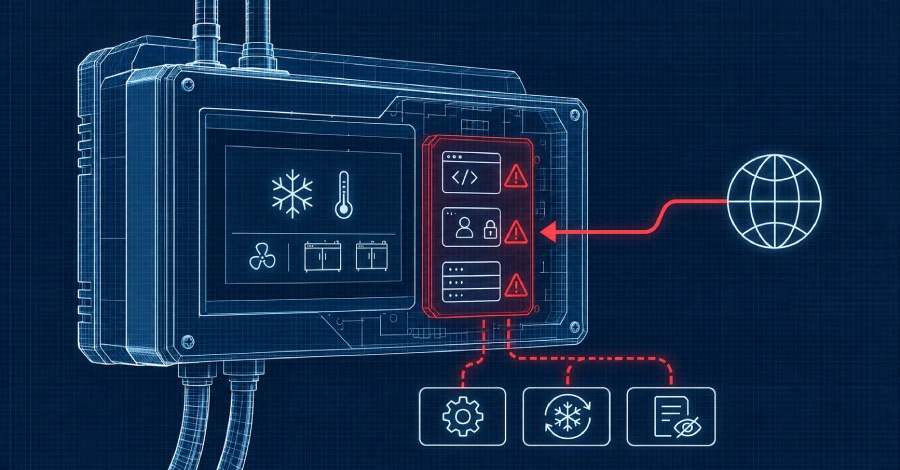
Six security vulnerabilities in Danfoss AK-SM800A refrigeration controllers could allow remote attackers to take control of affected devices without authentication, according to security researchers at Dutch cybersecurity consultancy Midnight Blue.
The researchers disclosed the vulnerabilities after examining the controller's firmware and demonstrated that some of the flaws could lead to remote code execution (RCE) with root privileges.
No security patch is currently available, and researchers warn that the latest firmware version, 5.4.0, does not fix the vulnerabilities.
Cybersecurity agencies in Belgium, Ireland, and Germany have issued warnings urging operators to immediately remove exposed controller management interfaces from the public internet.
Six Vulnerabilities Affect Danfoss AK-SM800A Controllers
The AK-SM800A is a refrigeration management controller used in supermarkets and other commercial environments to manage refrigerators, freezers, temperature settings, and defrost schedules.
Maintenance providers can also access these systems remotely for monitoring and management.
Security researcher Carlo Meijer from Midnight Blue identified six vulnerabilities during a manual review of firmware available from Danfoss. The investigation reportedly took less than an hour.
The researchers examined firmware version 5.3.2 and found that all versions up to and including that release were affected. No CVE identifiers have been assigned to the six vulnerabilities yet.
Five flaws affect unauthenticated web request handlers inside a program running with root privileges. Researchers demonstrated that one of these vulnerabilities could be exploited to execute arbitrary code as root on firmware version 3.3.0. They also identified the same vulnerabilities in version 5.3.2.
The sixth vulnerability affects the gateway responsible for enforcing the controller's Strict mode security protections.
Strict Mode Does Not Fully Protect Vulnerable Controllers
Danfoss AK-SM800A controllers include a security feature called Strict mode, which limits access to the web interface by requiring authentication, encrypted connections, and session tokens.
When enabled, Strict mode blocks most web requests from users who have not logged in.
However, researchers discovered that one of the six vulnerabilities exists inside the gateway responsible for enforcing these protections.
During testing, they ran firmware version 5.3.2 in an emulator with Strict mode enabled and triggered a crash in the gateway.
According to Midnight Blue, further work could potentially turn this crash into code execution. The gateway also lacks basic exploit mitigation mechanisms, including stack canaries.
This means enabling Strict mode alone cannot be considered sufficient protection against the vulnerabilities.
Attackers Could Take Complete Control of Refrigeration Systems
Successful exploitation could provide attackers with root-level access to the affected controller.
With this access, an attacker could:
- Modify refrigeration controller configurations.
- Change temperature setpoints and defrost schedules.
- Trigger unwanted defrost cycles.
- Manipulate alarm settings.
- Hide malicious activity from system logs.
- Install persistent malicious code.
- Potentially render the controller permanently unusable.
Researchers also found that the controllers do not implement secure boot.
This creates another security concern because attackers who gain sufficient control could install malicious code designed to survive factory resets and firmware updates.
In some cases, a compromised controller could remain unusable until the hardware is replaced.
Latest Firmware Version 5.4.0 Does Not Fix the Vulnerabilities
Danfoss lists firmware version 5.4.0, released in November, as the latest software package for the AK-SM800A.
However, Midnight Blue researchers stated that this release does not address the six vulnerabilities.
They noted that the firmware's file timestamp suggests it was built on October 29, before the second wave of cyberattacks and before their vulnerability reports were submitted.
Although the firmware release includes an updated password policy, neither its release notes nor the November update guide mentions fixes for the newly identified vulnerabilities.
Germany's Federal Office for Information Security (BSI) initially stated that version 5.4.0 was not affected. It later corrected its statement, explaining that it could not currently rule out the possibility that the latest version was vulnerable.
Danfoss has not published a security advisory or announced a release date for fixes addressing these six issues.
Disclosure Follows Cyberattacks Targeting European Supermarkets
The vulnerability disclosure comes amid recent cyberattacks targeting refrigeration systems at supermarkets across Europe.
Attacks in France reportedly began on October 11, followed by another wave affecting multiple European countries. The incidents caused unwanted defrost cycles and resulted in damaged or destroyed stock.
Germany's BSI confirmed that AK-SM800A controllers were involved in earlier incidents in which refrigeration systems across several countries were tampered with.
However, authorities and researchers have not established a connection between those incidents and the six newly disclosed vulnerabilities. The BSI also stated that it had no information about exploitation of these specific flaws.
Danfoss previously said that most affected units in France were either older models no longer receiving updates or current AK-SM800A controllers running outdated firmware.
The company had also addressed earlier AK-SM800A vulnerabilities in 2023 and 2025, including authentication bypass and command injection issues.
What Operators Should Do Immediately
With no confirmed security patch available, cybersecurity agencies are recommending immediate network isolation measures.
The Belgian Centre for Cybersecurity and Ireland's National Cyber Security Centre have issued guidance advising operators to take the following steps:
- Remove public internet exposure: Identify every AK-SM800A controller whose management interface is accessible from the internet, including through 4G or 5G connections, and remove direct exposure.
- Secure remote access: Allow remote administration only through a properly configured VPN or protected internal network. Restricting access to a maintenance provider's IP addresses through a firewall may be used as a temporary measure.
- Review controller configurations: Check temperature setpoints, defrost schedules, alarm settings, user accounts, and remote-access configurations for unauthorized changes.
- Change credentials: Replace default passwords and review all accounts with access to the controller.
- Enable Strict mode: Use the available authentication protections, but do not treat Strict mode as a replacement for network isolation.
- Install supported firmware: Keep controllers on the latest supported firmware while recognizing that version 5.4.0 does not resolve the six newly disclosed vulnerabilities.
- Investigate possible compromise: If suspicious activity is detected, change all credentials and verify that connected refrigeration equipment is operating correctly.
Operators should also coordinate with refrigeration service providers before interrupting the data connections used for remote monitoring. Contractual and insurance requirements may apply, and secure alternative access should be established to maintain monitoring capabilities.
Danfoss itself recommends that AK-SM800A controllers should never be directly accessible from the public internet, regardless of firmware version or whether Strict mode is enabled.
Conclusion
The six newly disclosed Danfoss AK-SM800A vulnerabilities highlight the risks of exposing industrial and operational technology systems to the public internet.
The possibility of unauthenticated remote code execution with root privileges makes these flaws particularly concerning for supermarket refrigeration infrastructure, where unauthorized changes can disrupt temperature controls and cause significant financial losses.
Until Danfoss releases verified security fixes, operators should prioritize network isolation, restrict remote access, review controller configurations, and investigate any signs of unauthorized activity.
Follow Hacklido for the latest cybersecurity news, vulnerability disclosures, and security research.
Connect with Hacklido:
- LinkedIn: https://www.linkedin.com/company/hacklido/
- Twitter / X: https://x.com/hacklido