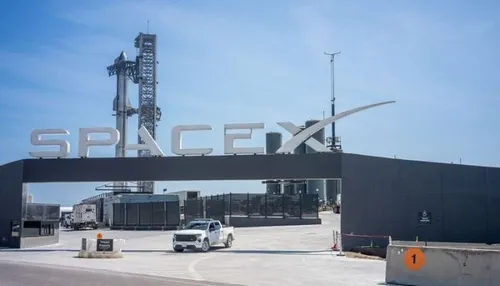
SpaceX is making a massive investment in artificial intelligence infrastructure, announcing plans to invest more than $74 billion in two supercomputing campuses in the United States.
The company plans to establish large-scale AI computing facilities at its Starbase location in Texas and in Cochise County, Arizona.
The announcement represents a major expansion of SpaceX's business beyond its traditional rocket launches and Starlink satellite internet services.
The investment also highlights the growing importance of AI computing infrastructure as technology companies compete to develop increasingly powerful artificial intelligence models.
According to Reuters, SpaceX expects to invest more than $24 billion in the Texas facility and approximately $50 billion in the proposed Arizona campus.
Two major AI supercomputing campuses
An aerial view of SpaceX's Starbase facility outside of Brownsville, Texas. Credit: SpaceX
Campus 1: Starbase, Texas
$24 billion+
Expected investment
- Located at SpaceX's Starbase site.
- Designed for large-scale AI computing.
- Will generate its own electricity.
- Expected to support more than 500 permanent jobs.
Cochise County, AZ 39.93 Acres — Vacant Land Syndicate
Campus 2: Cochise County, Arizona
$50 billion
Expected investment
- Requires local county approval.
- Expected to create around 5,500 construction jobs.
- Could support approximately 1,000 permanent jobs.
- Plans to use dry cooling technology.
Why is SpaceX investing so heavily in AI infrastructure?
Artificial intelligence requires enormous computing power.
Advanced AI models need powerful processors, high-performance servers and specialized data centers to process massive amounts of information.
These computing facilities are commonly called AI supercomputing campuses.
They provide the infrastructure needed for:
- Training advanced AI models.
- Running large language models.
- Processing massive datasets.
- Developing autonomous AI systems.
- Supporting AI research and development.
- Running complex scientific simulations.
By investing in its own computing infrastructure, SpaceX aims to strengthen its position in the rapidly expanding AI industry.
The expansion is particularly significant because Reuters reported that SpaceX's AI business generated more than half of its third-quarter revenue.
Thousands of jobs expected from the projects
The proposed campuses could generate substantial employment opportunities.
Texas project:
- More than 3,000 construction jobs have already been generated.
- More than 500 permanent jobs are expected once operational.
Arizona project:
- Approximately 5,500 construction jobs are expected.
- Around 1,000 permanent positions could be created.
These opportunities could benefit construction companies, electrical engineers, infrastructure specialists, data center technicians and other technology professionals.
MarketScreener
Environmental concerns and local opposition
Despite the scale of the investment, the projects have raised environmental and community concerns.
Large AI data centers require substantial electricity and cooling infrastructure.
Some residents are concerned about:
- Increased electricity demand.
- Water consumption.
- Environmental impacts.
- Local infrastructure pressure.
- The long-term effects of large industrial facilities.
SpaceX has stated that the Arizona campus will use dry cooling and does not plan industrial groundwater consumption.
The company also says it is working with local electricity cooperatives and that the project could reduce cooperative members' electricity bills by up to 20%.
However, the Arizona project faces opposition from some residents. A petition with approximately 2,400 signatures has asked local officials to reject the proposal.
A public hearing is scheduled for December 2026.
How will the Texas campus generate electricity?
One interesting aspect of the Texas project is its energy strategy.
Rather than relying entirely on the public electricity grid, SpaceX plans to generate its own electricity for the Starbase facility.
Public notices describe plans for a natural-gas-fired power plant on approximately 444 acres.
This approach could help the company meet the substantial electricity requirements of its AI computing operations.
However, independent assessment of the project's environmental impact and energy requirements will be important.
What does this mean for the global AI industry?
SpaceX's investment reflects a larger trend in the technology industry: competition is no longer limited to developing better AI models.
Companies are also competing to build the infrastructure required to operate them.
The investment could have several implications.
For AI companies:
- Greater availability of computing infrastructure.
- Increased competition in AI development.
- Potential expansion of advanced AI services.
For technology professionals:
- More opportunities in data center operations.
- Increased demand for cloud computing specialists.
- Greater demand for electrical and infrastructure engineers.
- Opportunities in AI hardware and networking.
For the global technology industry:
- More investment in AI supercomputing.
- Growing demand for advanced processors.
- Increased electricity requirements.
- Greater competition among AI infrastructure providers.